MICR printers, from a single desk to a million impressions a month
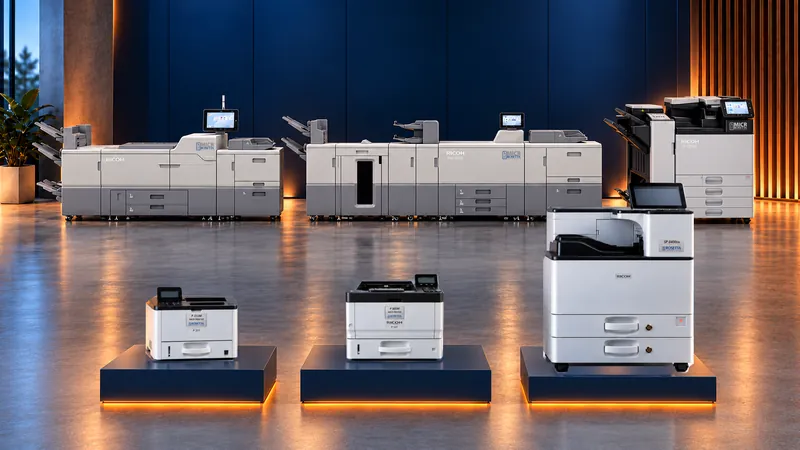
Eight MICR printers in two classes, from a 34 page per minute desktop unit to production systems that run to a million impressions a month. Every one is calibrated for the MICR line a bank reader/sorter reads, with ProMark™ MICR toner and the MICR Performance Guarantee behind it.
Rosetta Technologies builds on Ricoh engines your service organization already supports, instead of asking you to learn a proprietary machine.
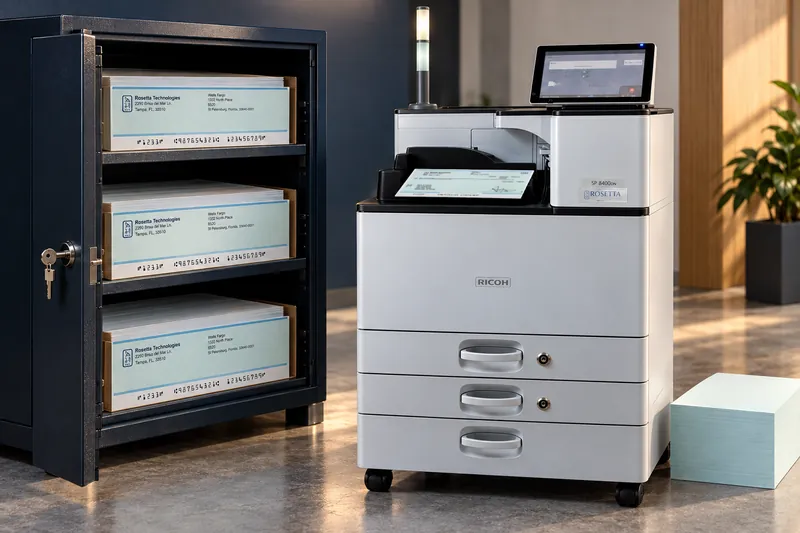
Why print on blank stock
Pre-printed stock
One product per account
Ordered in quantity
Stored under lock and counted
Obsolete when a bank, address, or account number changes
Destroyed, and reordered
Blank safety stock
One product covers every account, each check printed on demand
Change a template, not an inventory
Nothing to secure beyond the blank stock
Nothing to destroy when details change
Never short of a specific account’s forms
What a MICR printer removes from the building.
Start with volume
Two classes, chosen by what you print in a month
Speed is the number vendors lead with. Recommended monthly volume is the number that decides whether a machine lasts, and whether its MICR line stays inside tolerance.
4 models
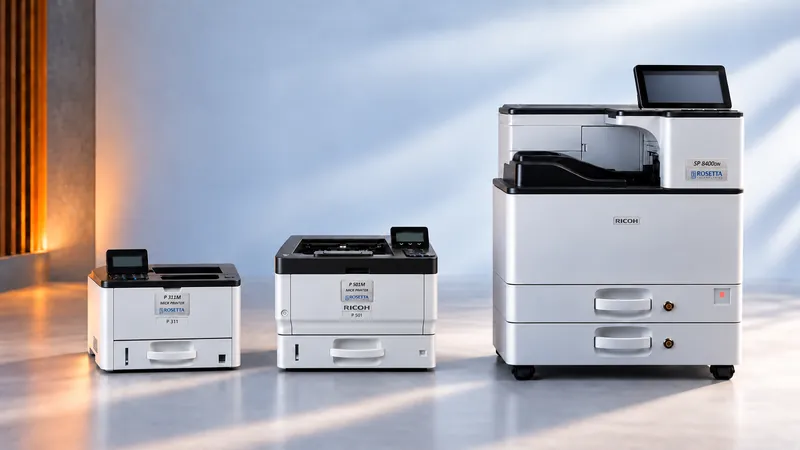
Workgroup MICR Printers
A workgroup MICR printer sits in the office with the people who run payroll or accounts payable. It prints checks on blank stock on demand, which is what removes pre-printed check stock from the building.
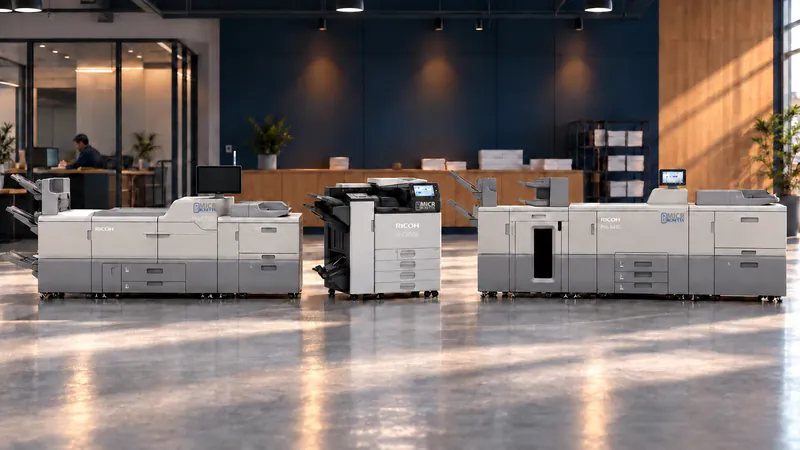
Production MICR systems run nightly cycles where a rejected batch is a missed settlement window, not an inconvenience. These machines are built for continuous duty and measured in impressions per month rather than pages per day.
Pro C7500PM, Pro 8410M / 8420M, Pro 8310M / 8320M, Pro C7210XM
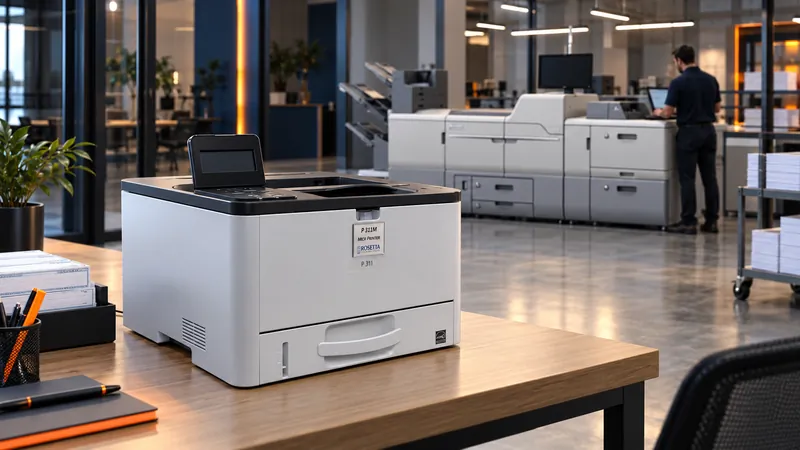
The P 311M stands 10.3 inches tall. The Pro 8420M stands 68.3 inches. A specification table flattens that difference into a row of numbers, so here are six of the machines side by side.
Heights of the six machines shown
P 311M
10.3 in tall
P 501M
12.2 in tall
SP 8400DNM
28.3 in tall
IP C8500M
30.7 in tall, main unit
Pro C7500PM
48 in tall, main unit
Pro 8410M / 8420M
68.3 in tall, including the attention lamp
Main unit only. Plan floor space from a quoted configuration, since feeders and finishers add width.
What makes a printer a MICR printer
Magnetic tonerIron oxide gives the characters a magnetic signature.
CalibrationProduction verified on a MICR verifier before it ships.
Certified fontsE-13B or CMC-7, tuned to the engine and the toner.
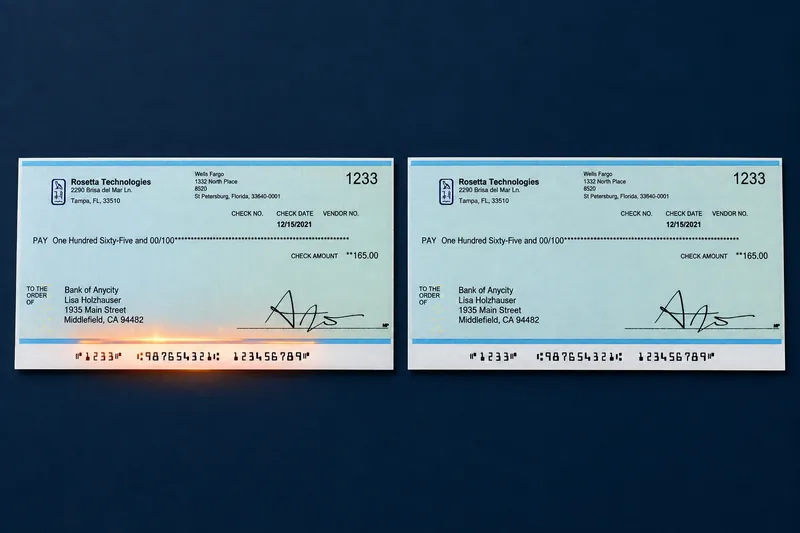
All three present, and the item clears. The reader/sorter reads the line. With only the toner, the check looks right to a person and is rejected by the machine.
A standard office printer loaded with MICR toner satisfies one of three requirements, which is why its output still gets rejected.
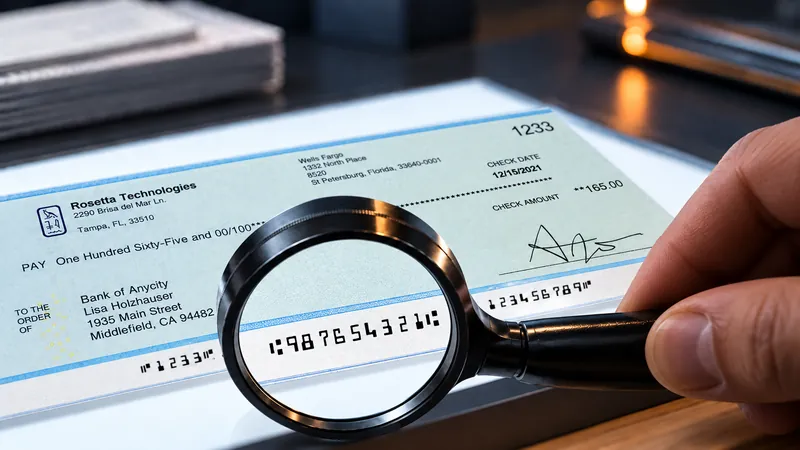
The full MICR line
Every MICR printer we build
Eight models across two classes, side by side.
All Rosetta Technologies MICR printers compared by speed, resolution, and monthly volume
Recommended monthly volumes. The IP C8500M, Pro 8410M / 8420M and Pro 8310M / 8320M figures are maximum monthly volumes. Maximum duty cycle is a survival rating. Running near it wears the fuser and drum, and worn parts weaken the MICR signal.
Recommended monthly volume across the line. Maximum duty cycle is a survival rating, not an operating target.
Before you compare models
What actually makes a printer a MICR printer
The most expensive mistake in this category is assuming that MICR is a supply rather than a system. It is three things working together, and a printer that has only one of them produces checks that look correct to a person and get rejected by a machine.
The toner
MICR toner carries iron oxide, which is what gives the characters a magnetic signature a reader/sorter can detect. ProMark™ MICR toner is the first polyester-based MICR toner in the industry. A polyester base holds together and tolerates heat better than the polystyrene base most MICR toner still uses, which is why independent testing puts its reject rate at 0.1% or lower against a 2% to 4% industry-typical range.
The calibration
Every one of our MICR printers is production verified before it ships. Toner is formulated per print engine rather than sold as one universal product, fonts are tuned per engine for E-13B and CMC-7 character definition, and output is evaluated on MICR verifier equipment. This is the part no supply purchase can replicate.
The fonts
E-13B is the North American standard and CMC-7 is used across much of Europe and South America. The characters are shaped the way they are so that each one produces a distinct waveform as it passes a read head. A visually similar font that was not built to that specification produces the wrong waveform, and the item is rejected.
Ten digits and four symbols: Transit, Amount, On-Us and Dash
CMC-7
Used across much of Europe and South America
Seven bars per character
The spacing between the bars encodes the character
Why the shapes look like that. Each character is shaped so that it produces a distinct waveform as it passes a magnetic read head. A visually similar font not built to that specification produces the wrong waveform, and the item is rejected.
Character forms shown are representative. Production output is set in the licensed fonts we tune per print engine.
The MICR Performance Guarantee
If your bank reports a MICR quality problem, we investigate it with your bank. Where the problem is verified as caused by our materials or modifications and cannot be resolved, we reimburse the fees your bank charges for rejected checks over their acceptable rate.
Applies to Rosetta Technologies branded Ricoh printers purchased in the United States or Canada from us or an authorized reseller, operated with approved supplies and our MICR fonts, and maintained under an approved service plan.
* Required. We use this to reply to you. Nothing else. See privacy. This form is protected by reCAPTCHA; the Google Privacy Policy and Terms of Service apply.