
A nightly cycle with no slack
Output is produced against a cutoff. A machine that stops for a supply change in the middle of the run costs more than the supply does.
A bank is the one buyer that sits on both sides of the MICR line. It prints items that have to clear, and it receives items that have to be read, returned, and replaced. Both jobs run on a clock that does not move.
Official checks, cashier checks, money orders, and the return item work that follows them all share the same failure mode. An item a reader/sorter cannot read stops being a print job and becomes a person opening an envelope by hand. We supply the printer, the software, and the toner as one path so that the reject rate is one vendor's responsibility rather than three.
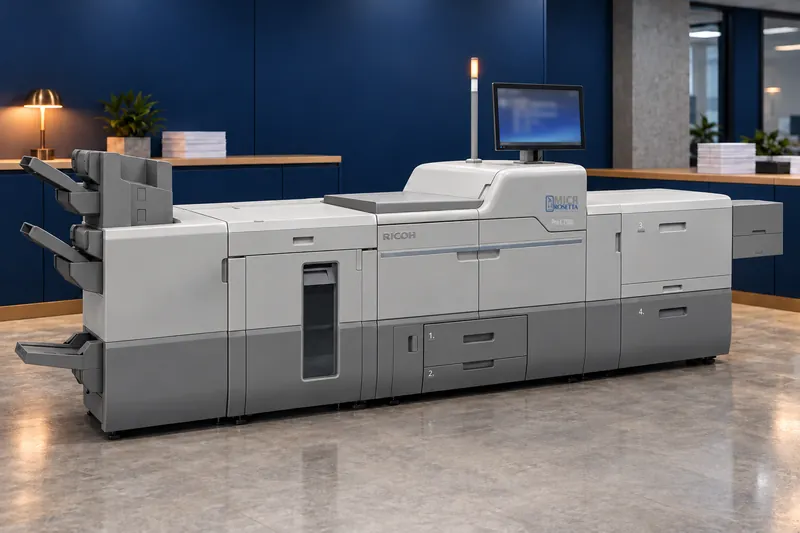
Output is produced against a cutoff. A machine that stops for a supply change in the middle of the run costs more than the supply does.
A reject is charged back at the bank's own fee schedule and handled by hand. The reject rate is a line item, not a quality score.
A returned item needs a legally equivalent Image Replacement Document, printed with its own MICR line so it can be presented again.
ASC X9 and ABA specifications govern the MICR line. Our MICR fonts are a condition of the performance guarantee.
Items the bank issues
Items returned to the bank
ProMark MICR, at a 0.1 percent reject rate or lower.
Each model below is sized to this buyer's monthly volume, with room for the peak month.
The Pro 8410M/8420M and Pro 8310M/8320M run to 1,000,000 impressions a month at 111 or 136 pages per minute. Where output needs color, the Pro C7500PM and Pro C7210XM carry up to 240,000 pages a month.
CheckStream composes the whole item onto blank safety stock in one pass, so no account has its own pre-printed inventory. OnSight takes an X9 cash letter and produces printed Image Replacement Documents.
ProMark MICR toner tests at a 0.1% reject rate or lower. Typical MICR toner in this industry rejects at 2% to 4%. Approved supplies and continuous maintenance are two of the five conditions the guarantee attaches to.
We cover bank fees for rejected checks over the bank's acceptable rate, where our materials caused the reject.
Five conditions apply together: a Rosetta Technologies branded printer, purchase from an authorized source, approved supplies, our MICR fonts, and continuous maintenance under an approved service plan. Mixing standard and MICR toner cartridges or photoconductor drum units is an explicit exclusion.
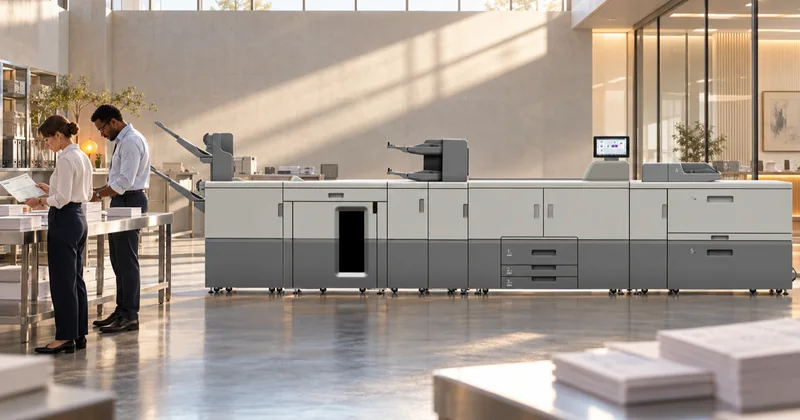
Back-office check operations run to a daily deadline, which is why throughput and reject rate matter more here than price per page.
The Pro 8410M/8420M and Pro 8310M/8320M run to a maximum of 1,000,000 impressions a month. The Pro C7500PM and Pro C7210XM carry a recommended volume of up to 240,000 pages a month. Duty cycles run higher than recommended volumes and are not the number to plan a nightly cycle against.
No. CheckStream prints the background, the logo, the security features, and the MICR line in the same pass onto blank safety stock. One stock covers every account, which removes the per-account inventory and the obsolescence that comes with it.
OnSight reads an X9.37, X9.100-180, or X9.100-187 cash letter file and produces X9.100-140 compliant Image Replacement Documents. OnSight Decision applies set criteria to route items automatically rather than by hand.
It covers bank fees for rejected checks over the bank's acceptable rate, where our materials caused the reject. Five conditions apply together: a Rosetta Technologies branded printer, purchase from an authorized source, approved supplies, our MICR fonts, and continuous maintenance under an approved service plan.
Payroll and claims work is defined by its deadline. The run is large, it happens on a date everyone already knows, and every rejected item is a person who did not get paid on the day they expected to be.
See the fitA healthcare payment is rarely just a check. It arrives with remittance detail the provider has to reconcile against claims, and the two have to stay together from the printer to the envelope.
See the fitA city finance office, a school district and a university bursar are running the same job: scheduled disbursements that cannot be late, paid to people who are not set up for electronic payment, under a purchasing policy that has to be satisfied before anything is bought.
See the fitBelow a certain volume the question is not throughput. It is whether a finance team should be storing, securing, counting, and destroying pre-printed check stock for every account it holds.
See the fitA commercial printer or mailing house is not printing its own checks. It is printing other organizations' checks, which changes the problem: many accounts, many templates, other people's deadlines, and a reject that is your fault and their money.
See the fitA return item arrives as a record in a cash letter file. It leaves as a physical document that carries its own MICR line, or it does not leave at all and somebody works it by hand.
See the fitIf you know the number, we can work out what a reject costs you a year. If you do not, that is the first thing to ask them.