
Stop holding stock per account
One blank product covers every account. Changing a bank or an address is a template change rather than an order, a shredder, and a wait.
Below a certain volume the question is not throughput. It is whether a finance team should be storing, securing, counting, and destroying pre-printed check stock for every account it holds.
Pre-printed stock has to be ordered in quantity, kept under lock and counted, destroyed and reordered whenever a bank, an address, or an account number changes, and it runs out of the one account that needs it. Printing on demand from blank safety stock replaces all of that with a template change. That is the whole argument at this size, and it does not depend on volume.

One blank product covers every account. Changing a bank or an address is a template change rather than an order, a shredder, and a wait.
Blank safety stock carries no account number and no bank. There is nothing to secure beyond the blank itself.
Bank fees for rejected items do not scale down with volume. The per-item cost of getting the MICR line wrong is the same as it is for a bank.
24/7 technical support is available to customers under a support plan, which matters more when there is no print operations team down the hall.
Small and mid-size business: what changes
Pre-printed stock
One product per account
Blank safety stock
One product, every account
The argument at this size is inventory, not throughput. It holds at four hundred checks a month as firmly as at four hundred thousand.
Each model below is sized to this buyer's monthly volume, with room for the peak month.
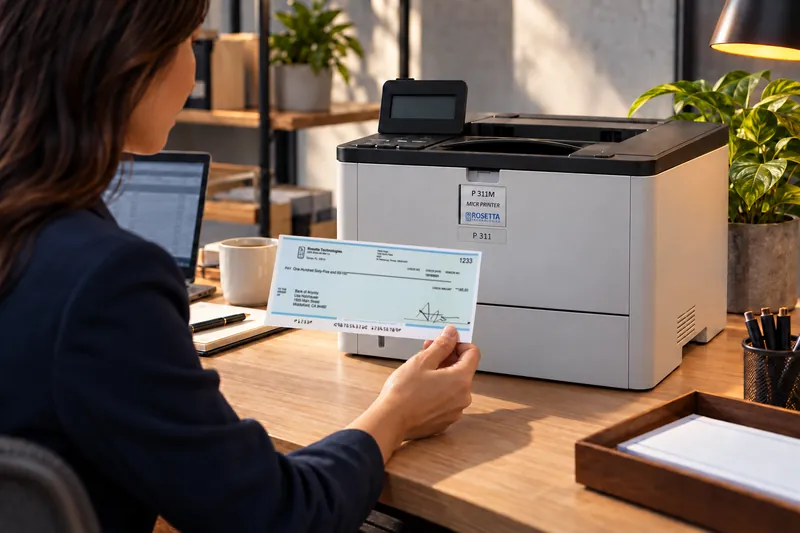
The P 311M runs at 34 pages per minute with a recommended volume of up to 5,800 a month. The P 501M runs at 45 pages per minute with up to 10,000 a month and room for optional trays. Both are desktop machines.
The business editions differ from one another on two rows only: maximum users and printer support. LS covers one user and one printer. Office covers up to five users. Every other capability in the matrix is identical.
ProMark MICR toner is formulated per print engine rather than sold as one universal product, and is independently tested at a 0.1% reject rate or lower. Blank safety stock replaces the pre-printed inventory entirely.
We cover bank fees for rejected checks over the bank's acceptable rate, where our materials caused the reject.
Five conditions apply together: a Rosetta Technologies branded printer, purchase from an authorized source, approved supplies, our MICR fonts, and continuous maintenance under an approved service plan. Mixing standard and MICR toner cartridges or photoconductor drum units is an explicit exclusion.
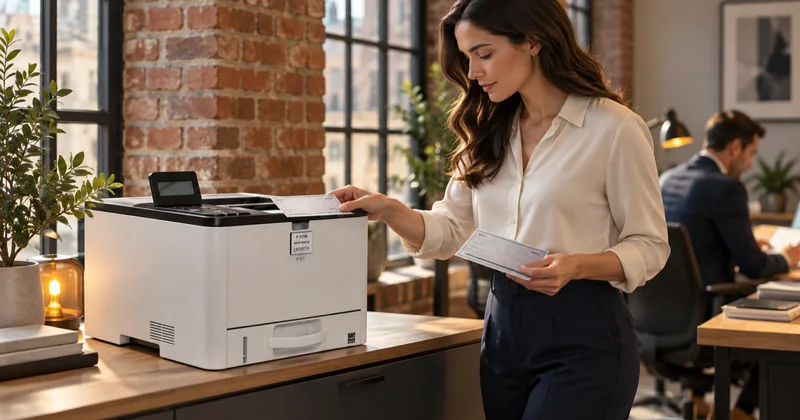
A short run collected from a desktop MICR printer. The magnetic line is the one a production system prints.
The case at this size is inventory rather than throughput. Pre-printed stock is ordered in quantity, stored securely, counted, and destroyed whenever bank details change. Blank safety stock removes that, and one blank covers every account regardless of how many checks are printed.
The P 311M is rated for up to 5,800 prints a month at 34 pages per minute. The P 501M is rated for up to 10,000 a month at 45 pages per minute. Choose against the recommended volume rather than the maximum duty cycle.
No. A MICR printer is calibrated and verified on a MICR verifier before it ships, and its fonts are tuned to that engine and that toner. Loading MICR toner into a standard office printer satisfies one of three requirements, and the output still gets rejected.
Check printing software to compose the item, ProMark MICR toner, and blank check safety stock meeting ANSI X9.18. Approved supplies and continuous maintenance under a service plan are two of the five conditions of the MICR Performance Guarantee.
A bank is the one buyer that sits on both sides of the MICR line. It prints items that have to clear, and it receives items that have to be read, returned, and replaced. Both jobs run on a clock that does not move.
See the fitPayroll and claims work is defined by its deadline. The run is large, it happens on a date everyone already knows, and every rejected item is a person who did not get paid on the day they expected to be.
See the fitA healthcare payment is rarely just a check. It arrives with remittance detail the provider has to reconcile against claims, and the two have to stay together from the printer to the envelope.
See the fitA city finance office, a school district and a university bursar are running the same job: scheduled disbursements that cannot be late, paid to people who are not set up for electronic payment, under a purchasing policy that has to be satisfied before anything is bought.
See the fitA commercial printer or mailing house is not printing its own checks. It is printing other organizations' checks, which changes the problem: many accounts, many templates, other people's deadlines, and a reject that is your fault and their money.
See the fitA return item arrives as a record in a cash letter file. It leaves as a physical document that carries its own MICR line, or it does not leave at all and somebody works it by hand.
See the fitAt this size the honest answer is often a desktop machine and a software license. Tell us the volume and we will say so if that is the case.