
Character signal strength
The measurement of the magnetic property of the toner. This is the one a reader/sorter reads directly.
ProMark™ MICR toner is the first polyester-based MICR toner in the industry. Independent testing puts its reject rate at 0.1% or lower, against an industry-typical range of 2% to 4%.
Most MICR toner is polystyrene-based. ProMark MICR toner is polyester-based, which gives it stronger cohesion properties and lets it withstand the higher temperatures inside a bank reader/sorter. That is the whole mechanism, stated plainly: the toner holds together where other toner begins to break down, so the magnetic signal on the line survives the trip.
We formulate the toner to work with each individual print engine rather than selling one universal product. A new printer is not added to the line until an exhaustive evaluation of its print engine, controller, and raster image processor is complete, and a toner has been developed to match that specific machine.
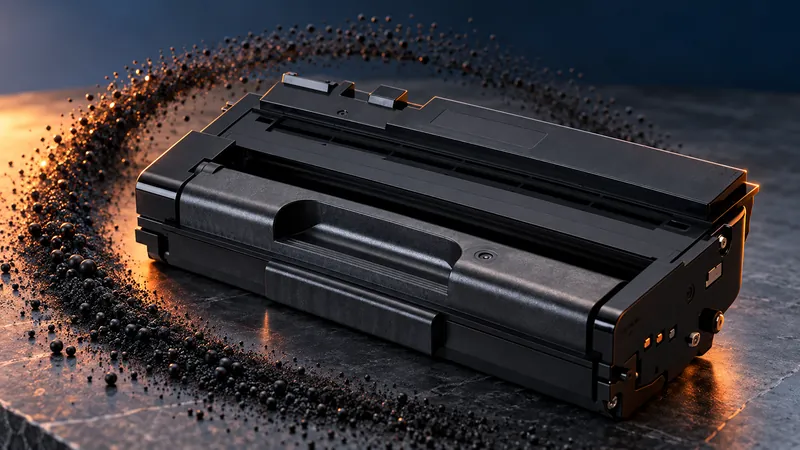
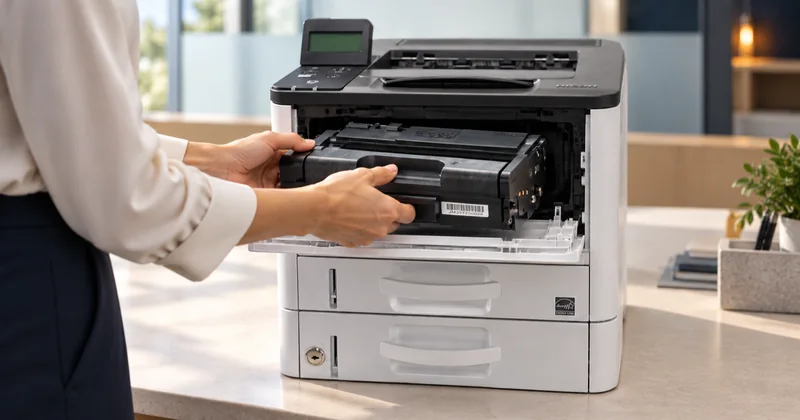
A worn fuser, the wrong toner, or paper outside the specification.
The reader/sorter cannot read it magnetically.
The item is processed by hand at the bank.
Charged on rejects above the rate your bank accepts.
ProMark MICR toner tests at a 0.1 percent reject rate or lower. The industry-typical range is 2 to 4 percent.
ProMark MICR toner independently tested on an IBM 3890 high-speed reader/sorter.
A team of chemists and engineers works the formulation for each MICR printer, so performance stays consistent across the life of the machine and adheres to national and international MICR standards.
The measurement of the magnetic property of the toner. This is the one a reader/sorter reads directly.
The ability to adhere or fuse to the paper.
The ability of toner molecules to adhere to each other. The polyester base is what improves this.
The performance of the toner through multiple passes in reader/sorters.
The measure of output expected per toner cartridge or bottle.
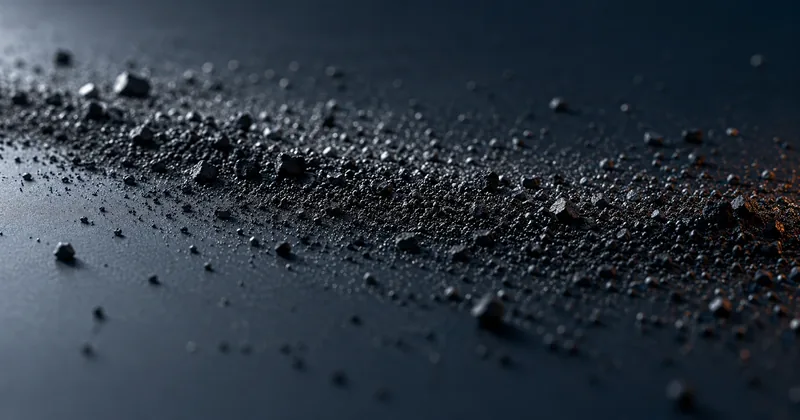
Particle size and consistency are what a per-engine formulation controls.
This is the part no supply purchase can replicate, and the reason our toner is not interchangeable with a generic MICR cartridge.
Fully configured standard printers are instrumented and tested, producing a performance database that describes the machine from first page out to full monthly duty cycle.
That data is used to create a MICR toner matched to the printer, delivering the signal strength, optical density, adhesion, cohesion, and yield that ANSI and bank specifications require.
Candidate toner is evaluated by printing MICR lines and running them through a MICR verifier. Formulations change and the process starts again. E-13B and CMC-7 fonts are tuned to both the engine and the toner.
Every MICR printer we ship is tested, and its sample checks are evaluated on a MICR verifier for signal strength, character formation, and toner adhesion.
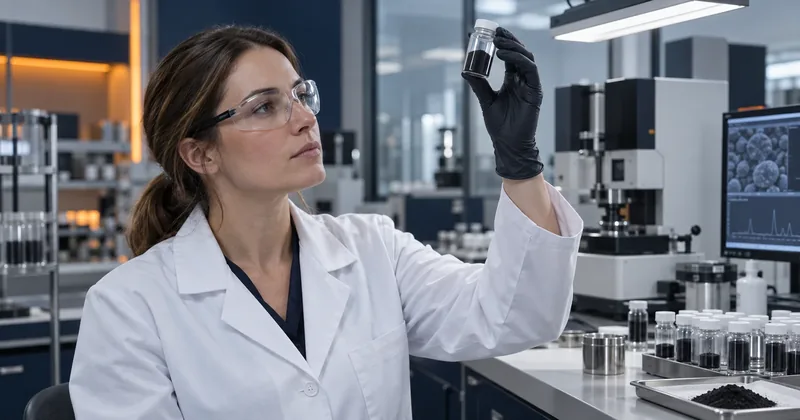
Formulating per print engine means a separate qualification for each one.
Yields are stated at the coverage percentage for each part, which is not the same across the line.
| Printer | Part number | Item | Yield |
|---|---|---|---|
| SP 3710DNM, P 311M | 10371000 | Toner Cartridge MICR | 5,000 at 4% |
| P 501M, IM 430FbM | 10501000 | Toner Cartridge MICR | 15,000 at 3.6% |
| SP C840DNM | 1084C000 | Print Cartridge MICR | 23,000 at 4% |
| SP 8400DNM | 10840000 | Toner MICR, one bottle | 50,000 at 4% |
| SP 3600DNM | 10451001 | Toner Cartridge MICR | 6,000 at 5% |
| SP 4510DNM | 10451000 | Toner Cartridge MICR, high yield | 10,000 at 5% |
| SP 4510DNM | 10451001 | Toner Cartridge MICR, low yield | 6,000 at 5% |
| SP 8200DN, SP 8300DN | 10820000 | Toner MICR, two pack | 72,000 at 5% |
| Pro 8310M, Pro 8320M | 10978000 | Toner Kit MICR ProMark, four bottles | 350,000 at 4% |
| Pro 8310M, Pro 8320M | 10978004 | Toner Kit MICR ProMark, four bottles, GB | 350,000 |
| Pro 8310M, Pro 8320M | 10978005 | Toner Kit MICR ProMark, six pack | 2.1 million at 4% |
| Pro 8100, Pro 8200 | 10877600 | Toner Kit MICR ProMark, four bottles | 300,000 at 4% |
| Pro 8100, Pro 8200 | 10877601 | Toner Kit MICR ProMark, six pack | 1.8 million at 4% |
| Pro C7210XM | 1072C000 | Toner MICR ProMark, one bottle | 70,000 at 4% |
| Printer | Part number | Item | Yield |
|---|---|---|---|
| P 501M, IM 430FbM | 10501001 | Drum MICR | 40,000 |
| P 501M, IM 430FbM, Canada | 10501003 | Drum MICR | 40,000 |
| SP C840DNM | 1084C001 | Drum Unit MICR | 60,000 |
| SP 4510DNM, SP 3600DNM | 10451002 | Drum MICR | 20,000 |
| Printer | Part number | Item | Yield |
|---|---|---|---|
| Pro 8310M, Pro 8320M | 10978001 | Developer MICR ProMark | 900,000 |
| Pro 8310M, Pro 8320M, GB | 10978006 | Developer MICR ProMark | 900,000 |
| Pro 8100, Pro 8200 | 10877605 | Developer MICR ProMark, one bottle | 900,000 |
| Pro 8100, Pro 8200 | 10877606 | Developer MICR ProMark, four pack | 900,000 |
| Pro C7210XM | 1072C001 | Developer MICR ProMark, one bottle | Not published |
Yields are at 4% coverage unless stated. Part 1072C000 for the Pro C7210XM is rated at 65,000 to 70,000 impressions.
Purchased in the United States or Canada.
Rosetta Technologies or an authorized reseller.
Toner, developer, cartridges, maintenance kits and PCDUs.
E-13B and CMC-7 as supplied.
An approved service plan or an approved provider.
Miss one and the guarantee does not apply. Mixing standard and MICR parts is explicitly excluded.
What it pays: bank fees for rejected checks above the acceptable rate your bank sets, where Rosetta Technologies materials caused the rejection.
MICR toner carries iron oxide, which gives the printed characters a magnetic signature a bank reader/sorter can detect. Ordinary toner has no magnetic content, so a check printed with it looks correct to a person and carries no usable signal for a machine.
Most MICR toner is polystyrene-based. A polyester base has stronger cohesion properties, meaning the toner molecules hold to each other better, and it withstands the higher temperatures inside a reader/sorter. That is what keeps the magnetic signal intact through multiple passes.
No. Mixing standard and MICR toner cartridges or photoconductor drum units is both a print-quality problem and an explicit exclusion from the MICR Performance Guarantee. The workgroup printers support swapping the complete MICR assembly for a complete standard assembly, which is a different thing.
Yes. We formulate the toner to match each individual print engine rather than selling one universal product. A new printer is characterized from first page out to full monthly duty cycle, and a toner is developed against that performance data.
Tell us your monthly volume and what you are running now. That is enough for a real answer rather than a brochure.