
Read by people
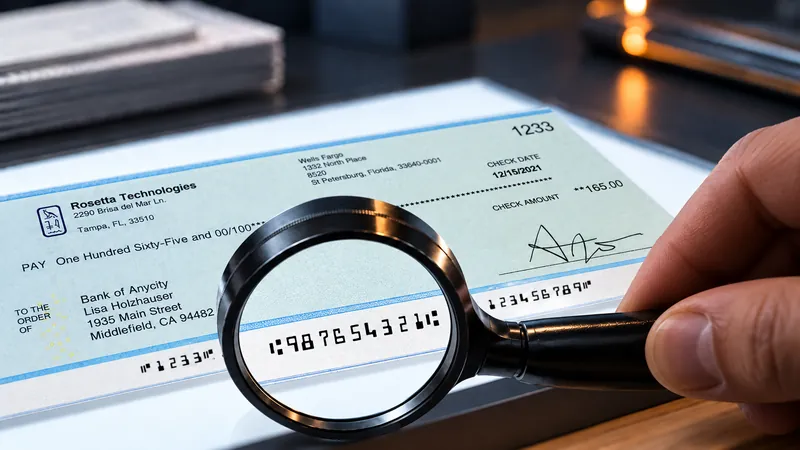
The payee, the amount, the date and the signature, printed to be read by eye. A person can also read the MICR line, which is why its characters are shaped like numbers at all.
The Rosetta Stone did that in 196 BC. A MICR line does it on every check you print. Making sure the person, the bank and the machine all read the same thing is the whole of our work.
In July 1799, soldiers rebuilding a fort near the Egyptian town of Rashid, which Europeans called Rosetta, dug out a broken slab of dark granodiorite. Carved into it was a decree issued at Memphis in 196 BC on behalf of the young king Ptolemy V.
The decree was written out three times, in three scripts: hieroglyphs for the temples, Demotic for everyday business, and ancient Greek for the administration. The priests who issued it wanted every reader in the kingdom to read the same words.
That redundancy is what made the stone famous. Scholars could already read the Greek, so the Greek became the key to the other two. In 1822 Jean-François Champollion announced that he had deciphered the hieroglyphs, and a writing system nobody had read for well over a thousand years opened up again. The stone has been in the British Museum since 1802.
Rosetta Technologies was founded in 1987 and has worked in magnetic ink character recognition ever since. The name recalls the stone, and the idea carved into it is the one we build to.
Two MICR font standards
E-13B
The North American standard
CMC-7
Used across much of Europe and South America
Why the shapes look like that. Each character is shaped so that it produces a distinct waveform as it passes a magnetic read head. A visually similar font not built to that specification produces the wrong waveform, and the item is rejected.
Every check is written twice: once for the person who reads it, once for the machine that clears it.
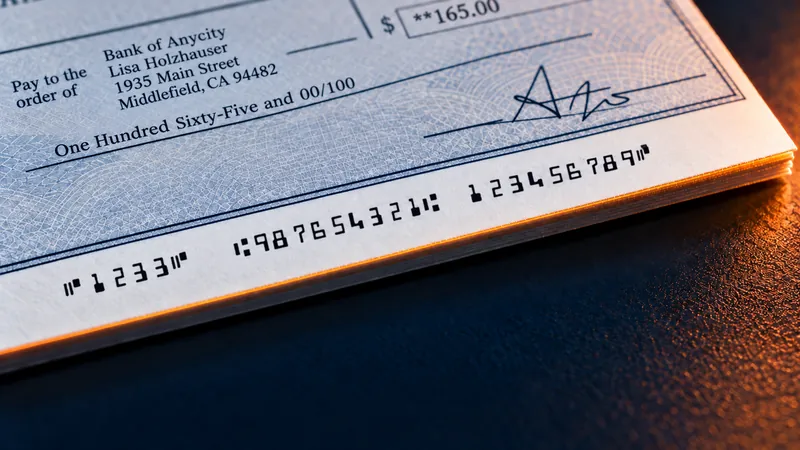
Look at the bottom edge of any check. The routing number, the account number and the check number appear in the body for you, and again along the bottom in a line of squared-off characters called E-13B.
The payee, the amount, the date and the signature, printed to be read by eye. A person can also read the MICR line, which is why its characters are shaped like numbers at all.
A bank reader/sorter reads the MICR line by its magnetic signal, not by sight. The toner carries iron oxide, and each of the fourteen E-13B characters, ten digits and four symbols, is shaped to produce its own waveform as it passes the read head.
When the two readings agree, the check clears without a person touching it. When the machine cannot read what the eye can, the item is rejected, handled by hand at the bank and billed back to you. The value of a MICR line is that one message reads the same way to every reader, which is exactly what the stone was carved to do.
Every product we make turns one kind of record into another without losing a character on the way.
CheckStream composes the check, its design and the MICR line on blank safety stock in one pass, straight from the payment data.
Check printing softwareWe re-engineer proven Ricoh print engines with toner formulated for each one, calibration verified on a MICR verifier, and fonts tuned to the pairing.
MICR printersProMark™ MICR toner, the first polyester-based MICR toner in the industry, independently tested at a 0.1% reject rate or lower against a 2% to 4% industry norm.
ProMark MICR tonerOnSight reads an X9.37 cash letter file and prints X9.100-140 compliant Image Replacement Documents, so a returned item can be handled again.
Returns processingA check print path usually involves three vendors: one for the printer, one for the software, one for the toner. When a bank rejects an item, each can point at the other two.
We supply all three, which is why we can put a guarantee on the output rather than on a part. Ricoh describes us as its partner in engineering MICR versions of its laser printers. The engines come from Ricoh. The MICR path, the toner, the fonts, the software and the MICR Performance Guarantee come from us.
We read the magnetic signal on a real check from your environment and tell you what a bank reader/sorter sees. No cost, no obligation.