
Item amount
Disposition by the value of the item, so small items and large items follow different paths.
OnSight Decision adds a decisioning engine to returns processing: it reads incoming X9 Image Cash Letter files against criteria you set and decides whether each item is re-presented, charged back, or flagged for review.
The manual version of this job is a person opening each returned item and deciding whether it should go back for payment or go to the customer as a chargeback. At any volume, that is slow, and it is where risk accumulates: an item held too long is an item that cannot be re-presented.
The Decisioning Engine reviews incoming files against rules you define and dispositions each item automatically. It can run fully automatically, fully manually, or automatically with manual override, which is usually how a team adopts it: override first, then trust.
The engine reads each item in an incoming X9 Image Cash Letter file against criteria you set, and routes it to one of three outcomes.
Disposition by the value of the item, so small items and large items follow different paths.
An item already presented twice is a different decision from a first return.
The reason the item came back drives the disposition directly.
The item goes back for payment.
The item is printed and mailed to the customer as a chargeback.
The item is flagged for manual review rather than decided automatically.

What an IRD carries
Printed on demand, because the MICR line is specific to the item.
The merged chargeback letter is the quiet time-saver. A chargeback normally means assembling four things: the notification, the explanation of the charge, the legal rights disclosure, and the IRD itself. OnSight Decision produces them as one formatted document with the IRD as a tear-off, which removes the manual collation step entirely.
| Operating system | Windows 7, 8, and 10; Windows Server 2008 R2 and 2012 R2 |
|---|---|
| Processor | Intel Core i3 or higher |
| Memory | 1 GB |
| Network | 100 Mb/s Ethernet |
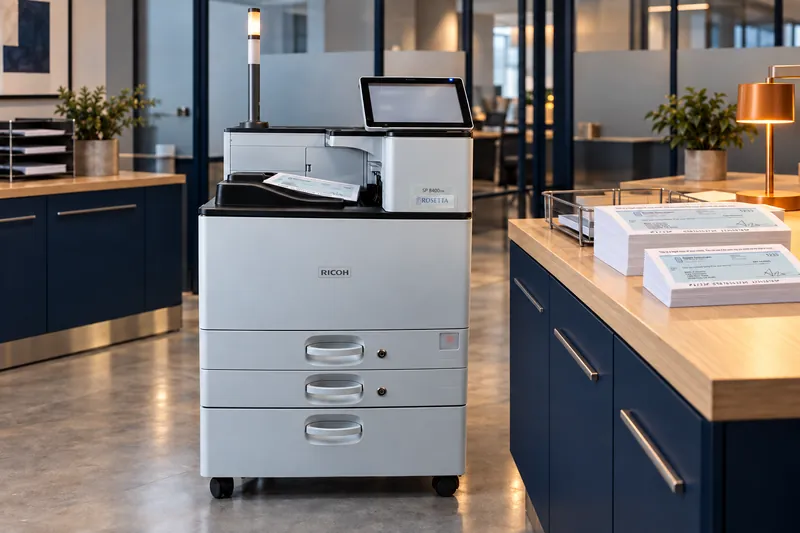
| Printer | A Rosetta Technologies certified MICR printer is required |
| Resolution | 1200 x 1200 dpi |
|---|---|
| Print speed | 31 ppm |
| Paper capacity | 850 sheets total |
| Connectivity | USB 2.0, Ethernet, TCP/IP |
| Power | 850W maximum |
| Monthly capacity | 1,050 to 9,000 IRDs per month in three-up format |
Pricing and licensing come with a quotation. Ask for one.