
A date that does not move
The run happens on a schedule set by the pay period or the claims cycle. Capacity has to cover the peak, not the average.
Payroll and claims work is defined by its deadline. The run is large, it happens on a date everyone already knows, and every rejected item is a person who did not get paid on the day they expected to be.
This is the buyer for whom a 2% reject rate is not an abstraction. On a twenty thousand item run it is four hundred people. We formulate ProMark MICR toner per print engine rather than selling one universal product, which is where the difference between a 0.1% reject rate and an industry-typical 2% to 4% comes from.
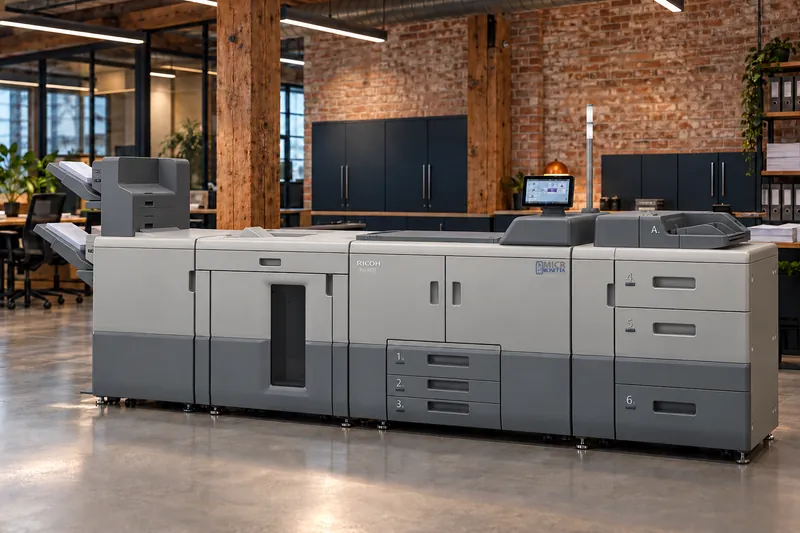
The run happens on a schedule set by the pay period or the claims cycle. Capacity has to cover the peak, not the average.
At an industry-typical 2% to 4%, a twenty thousand item run produces four hundred to eight hundred items that a bank handles by hand and charges for.
Printing on demand from blank safety stock removes the separate pre-printed inventory for each account, and the reorder that follows any change.
The background, the logo, and the security features print in the same pass as the MICR line, so nothing of value sits in a drawer between runs.
Payroll and claims: what a reject rate costs on a twenty thousand item run
Items a bank handles by hand, and charges for. Every rejected item on a payroll run is a person who was not paid on the day they expected to be. That is why the rate matters more than the toner price.
Item counts are arithmetic on a twenty thousand item run. Rates are the ProMark figure and the industry-typical range.
Each model below is sized to this buyer's monthly volume, with room for the peak month.
The SP 8400DNM handles up to 53,000 pages a month at 60 pages per minute. Above that, the Pro C7500PM handles up to 240,000 pages a month. Pick the band the peak run falls inside, not the average month.
Accounting data, the check template, and the MICR font merge in one pass. Six editions differ on two rows: maximum users and printer support. Every other capability in the matrix is identical across LS, Office, and Pro.
A maintenance kit replaces the fuser, drum, transfer roller, pickup rollers, and separation pads before wear shows up in a reject report. Fuser condition affects how toner adheres, which is why kits are a condition of the guarantee.
We cover bank fees for rejected checks over the bank's acceptable rate, where our materials caused the reject.
Five conditions apply together: a Rosetta Technologies branded printer, purchase from an authorized source, approved supplies, our MICR fonts, and continuous maintenance under an approved service plan. Mixing standard and MICR toner cartridges or photoconductor drum units is an explicit exclusion.

An insurance claims operation. Claim checks and explanation-of-benefit documents print to a fixed date each cycle.
Plan against the recommended monthly volume, not the maximum duty cycle. The SP 8400DNM handles up to 53,000 pages a month and the Pro C7500PM up to 240,000. Duty cycle figures are higher and describe a limit rather than a sustainable workload.
Checks print on blank check safety stock, which ANSI X9.18 specifies at 24 lb, Sheffield smoothness 120 to 150, 4.5% moisture content, and no ferromagnetic material in the paper. Stock outside the specification produces rejects on a printer in perfect calibration.
No. Magnetic toner is one of three requirements. The printer also has to be calibrated and verified on a MICR verifier before it ships, and it has to use certified E-13B or CMC-7 fonts tuned to that engine and toner. Toner alone satisfies one of the three, which is why that output still gets rejected.
On a twenty thousand item run, 0.1% is twenty items. At an industry-typical 2% to 4% it is four hundred to eight hundred. The ProMark figure was independently tested on an IBM 3890 high-speed reader/sorter.
A bank is the one buyer that sits on both sides of the MICR line. It prints items that have to clear, and it receives items that have to be read, returned, and replaced. Both jobs run on a clock that does not move.
See the fitA healthcare payment is rarely just a check. It arrives with remittance detail the provider has to reconcile against claims, and the two have to stay together from the printer to the envelope.
See the fitA city finance office, a school district and a university bursar are running the same job: scheduled disbursements that cannot be late, paid to people who are not set up for electronic payment, under a purchasing policy that has to be satisfied before anything is bought.
See the fitBelow a certain volume the question is not throughput. It is whether a finance team should be storing, securing, counting, and destroying pre-printed check stock for every account it holds.
See the fitA commercial printer or mailing house is not printing its own checks. It is printing other organizations' checks, which changes the problem: many accounts, many templates, other people's deadlines, and a reject that is your fault and their money.
See the fitA return item arrives as a record in a cash letter file. It leaves as a physical document that carries its own MICR line, or it does not leave at all and somebody works it by hand.
See the fitThe peak is what the equipment has to survive, not the average. Tell us the peak and the deadline it has to clear.