
Files in, documents out
OnSight accepts X9.37, X9.100-180, and X9.100-187 cash letter files and produces documents that satisfy X9.100-140.
A return item arrives as a record in a cash letter file. It leaves as a physical document that carries its own MICR line, or it does not leave at all and somebody works it by hand.
An Image Replacement Document is the legal equivalent of the original item, which is why it cannot be printed on ordinary paper with ordinary toner. It carries a MICR line specific to itself. Blank IRD stock plus magnetic toner is the only combination that works, and OnSight is the software that turns the file into the document.
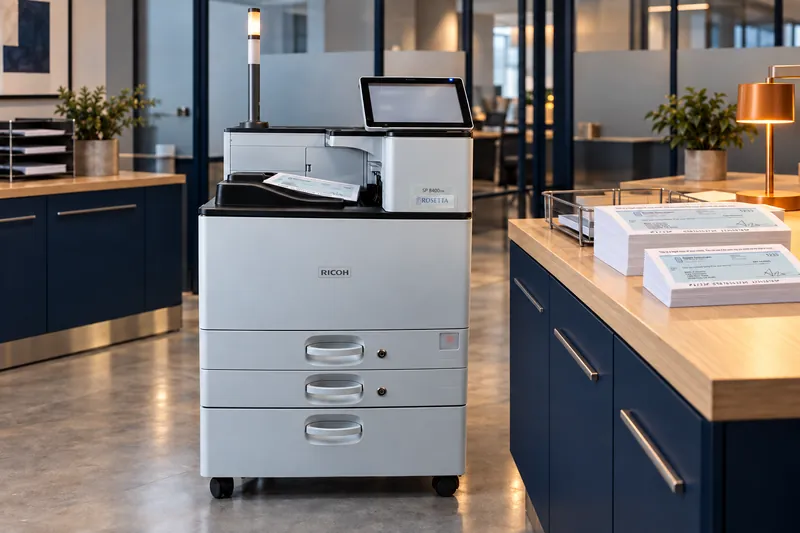
OnSight accepts X9.37, X9.100-180, and X9.100-187 cash letter files and produces documents that satisfy X9.100-140.
OnSight Decision applies set criteria to route items to re-present, charge back, or hold, rather than routing every item to a queue.
The line is specific to the replacement document, so it cannot be pre-printed. It has to be produced at the same time as the document.
An audit log and a detail report record what happened to each item, which is what makes the disposition defensible after the fact.
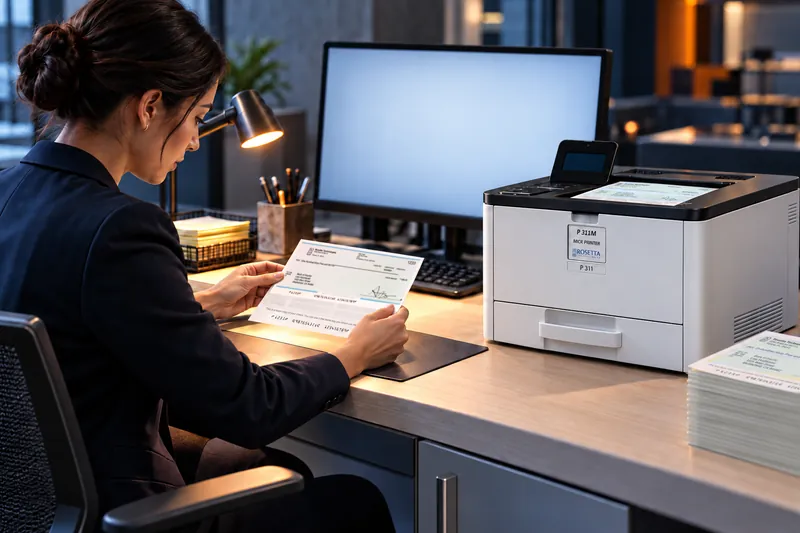
Check return and IRD teams: file in, document out
An Image Replacement Document carries the front and back of the original. The MICR line on an IRD is specific to that document, so it cannot be pre-printed. Blank stock plus magnetic toner is the only combination that works.
Formats OnSight accepts and produces.
Each model below is sized to this buyer's monthly volume, with room for the peak month.
OnSight receives the cash letter, transforms it under industry and business rules, prints the IRD, and monitors the result. OnSight Decision turns three criteria into three dispositions without a person in the loop.
Output from OnSight prints only on its paired OnSight MICR printer. Every laser engine behaves differently, so the software and the printer are designed together to land print elements correctly on each IRD. It also removes the possibility of redirecting output to another device.
Blank IRD stock is 24 lb, two-perf, and takes magnetic toner. Because the MICR line is specific to the item, blank stock plus magnetic toner is the only combination that produces a presentable document.
We cover bank fees for rejected checks over the bank's acceptable rate, where our materials caused the reject.
Five conditions apply together: a Rosetta Technologies branded printer, purchase from an authorized source, approved supplies, our MICR fonts, and continuous maintenance under an approved service plan. Mixing standard and MICR toner cartridges or photoconductor drum units is an explicit exclusion.

Returned items arrive as paper and as records, and both have to end up in the same place.
OnSight accepts X9.37, X9.100-180, and X9.100-187 cash letter files, and produces Image Replacement Documents that satisfy X9.100-140.
An Image Replacement Document carries a MICR line specific to that item. Because the line differs per document, it has to be produced at print time. Blank IRD stock plus magnetic toner is the only combination that works.
No. Output from OnSight can only be printed on the OnSight MICR printer it is paired with. Print engines behave differently, so the two are designed together so that print elements land correctly and the MICR line is accepted by a reader/sorter. It also removes the possibility of redirecting output elsewhere.
It applies three criteria, including the item amount and the number of times an item has been presented, and routes each item to one of three dispositions: re-present, charge back, or hold for review.
A bank is the one buyer that sits on both sides of the MICR line. It prints items that have to clear, and it receives items that have to be read, returned, and replaced. Both jobs run on a clock that does not move.
See the fitA branch prints a small number of items that carry the bank's name: official checks, cashier checks and money orders. Each one is read by the same reader/sorter as an item printed in the operations center, and each one is printed where nobody from operations is in the room.
See the fitPayroll and claims work is defined by its deadline. The run is large, it happens on a date everyone already knows, and every rejected item is a person who did not get paid on the day they expected to be.
See the fitA healthcare payment is rarely just a check. It arrives with remittance detail the provider has to reconcile against claims, and the two have to stay together from the printer to the envelope.
See the fitA city finance office, a school district and a university bursar are running the same job: scheduled disbursements that cannot be late, paid to people who are not set up for electronic payment, under a purchasing policy that has to be satisfied before anything is bought.
See the fitBelow a certain volume the question is not throughput. It is whether a finance team should be storing, securing, counting, and destroying pre-printed check stock for every account it holds.
See the fitA commercial printer or mailing house is not printing its own checks. It is printing other organizations' checks, which changes the problem: many accounts, many templates, other people's deadlines, and a reject that is your fault and their money.
See the fitThe second number is the one that decides whether decisioning pays for itself. Most operations have never counted it.