
The short answer
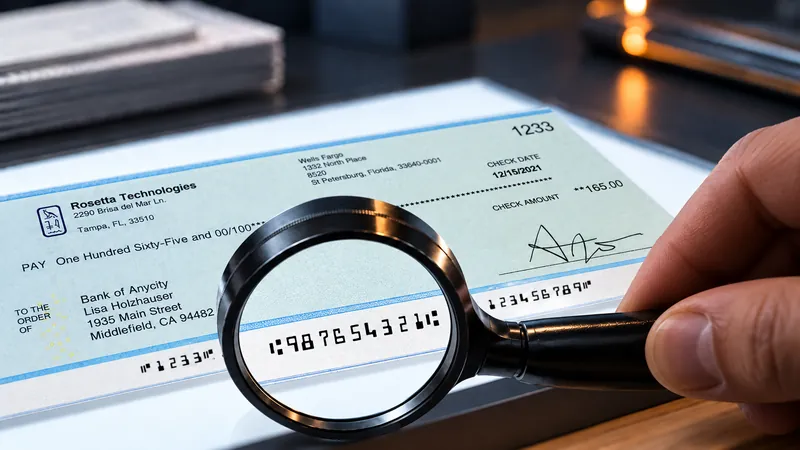
MICR is a way of printing characters so that a machine can read them by their magnetic signal rather than by their shape. The characters are printed in toner or ink containing iron oxide. When the item passes a magnetic read head, each character produces a distinct waveform, and the machine identifies the character from that waveform.
This matters because shape recognition is fragile and magnetism is not. A smudge, a stamp, a fold, or a signature crossing the line will confuse a system reading shapes. A magnetic read head reads through all of it, because it is not looking at the character at all. It is measuring the amount of magnetic material passing under it at each instant.
That is the whole idea, and it has held since the 1950s for the same reason that a barcode has held: it was designed for a machine rather than adapted for one.
The two font standards
Two MICR character sets are in use worldwide, and which one applies is decided by geography rather than by preference.
E-13B
E-13B is the North American standard, and it is also used across much of the rest of the world. It has fourteen characters: the ten digits, and four symbols that mark the boundaries of each field on the line. The symbols are named Transit, Amount, On-Us, and Dash.
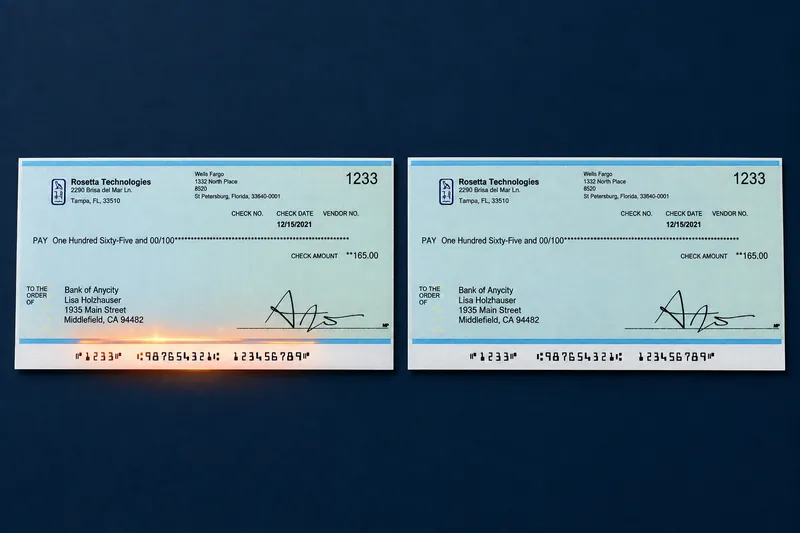
E-13B characters are blocky, with square edges and deliberately uneven mass. That uneven distribution is what produces the distinct waveform. A typeface that merely looks like E-13B, drawn to be legible to a person rather than to a read head, produces the wrong waveform and the item is rejected.
CMC-7
CMC-7 is used across much of Europe and South America. Rather than blocky character shapes, each CMC-7 character is drawn as seven vertical bars, and the character is encoded by the spacing between those bars rather than by the outline of the character.
We supply both, tuned to the print engine and the toner they run on.
Two MICR font standards
E-13B
The North American standard
- Blocky characters of uneven mass
- Ten digits and four symbols: Transit, Amount, On-Us and Dash
CMC-7
Used across much of Europe and South America
- Seven bars per character
- The spacing between the bars encodes the character
Why the shapes look like that. Each character is shaped so that it produces a distinct waveform as it passes a magnetic read head. A visually similar font not built to that specification produces the wrong waveform, and the item is rejected.
Why MICR toner alone is not enough
This is the single most expensive misunderstanding in the category. Magnetic toner is one of three requirements, and a printer that satisfies only one of them produces output that looks correct to a person and is rejected by the machine.
- Magnetic toner. Iron oxide in the toner gives the characters a magnetic signature. Without it there is no signal to read at all.
- Calibration. A MICR printer is verified on a MICR verifier before it ships, which confirms that the signal strength the machine actually produces falls inside tolerance. Signal strength is affected by the engine, the fuser, and the toner together, so it has to be measured on the assembled machine rather than assumed.
- Certified fonts. E-13B or CMC-7 fonts tuned to that engine and that toner. A visually similar font that was not built to the specification produces the wrong waveform.
All three together make a printer a MICR printer. Loading MICR toner into a standard office printer satisfies one of the three, which is why that output still gets rejected, and why the rejection is often intermittent and hard to diagnose.
What makes a printer a MICR printer
- Magnetic tonerIron oxide gives the characters a magnetic signature.
- CalibrationProduction verified on a MICR verifier before it ships.
- Certified fontsE-13B or CMC-7, tuned to the engine and the toner.
All three present, and the item clears. The reader/sorter reads the line. With only the toner, the check looks right to a person and is rejected by the machine.
What a reject actually costs
When a reader/sorter cannot read the MICR line, the item leaves straight-through processing. A person at the bank handles it by hand, and the bank charges for that handling at its own fee schedule. A reject is not a quality score. It is a fee.
The rate is where the difference between suppliers shows up. Our ProMark™ MICR toner is independently tested at a 0.1% reject rate or lower on an IBM 3890 high-speed reader/sorter. Typical MICR toner in this industry rejects at 2% to 4%.
| Toner | Reject rate | Items rejected on a 20,000 item run |
|---|---|---|
| ProMark MICR toner | 0.1% or lower | 20 |
| Industry typical, low end | 2% | 400 |
| Industry typical, high end | 4% | 800 |
Item counts are arithmetic applied to a twenty thousand item run. The rates are the ProMark figure and the industry-typical range.
On a payroll run, those rejected items are people who were not paid on the day they expected to be. In a bank, they are items that did not clear on the cycle they were supposed to clear on. The per-item fee is the smaller half of the cost.
Why a reject rate is a cost rather than a quality score
A weak MICR signal
A worn fuser, the wrong toner, or paper outside the specification.
The bank rejects the item
The reader/sorter cannot read it magnetically.
Exception handling
The item is processed by hand at the bank.
A bank fee
Charged on rejects above the rate your bank accepts.
The toner is the first link in that chain
ProMark MICR toner tests at a 0.1 percent reject rate or lower. The industry-typical range is 2 to 4 percent.
ProMark MICR toner independently tested on an IBM 3890 high-speed reader/sorter.
The paper is part of the system
Check stock that misses the specification produces rejects on a printer in perfect calibration, which is why paper is the most commonly missed variable when a reject rate climbs.
ANSI X9.18 sets what check stock has to be. The requirements that matter most in practice are weight, surface smoothness, moisture content, and the absence of any ferromagnetic material in the paper itself, since the paper must not contribute a magnetic signal of its own.
| Requirement | Specification |
|---|---|
| Weight | 24 lb, 90 g/m², recommended |
| Smoothness | Sheffield 120 to 150 |
| Moisture content | 4.5% |
| Wrapping | Sealed, moisture-proof |
| Ferromagnetic material | None in the paper |
Moisture content and sealed wrapping travel together. Paper that has absorbed moisture in storage behaves differently through the fuser, and fusing is what fixes the toner to the sheet. A change in how well toner adheres is a change in signal strength.
Pre-printed stock against printing on demand
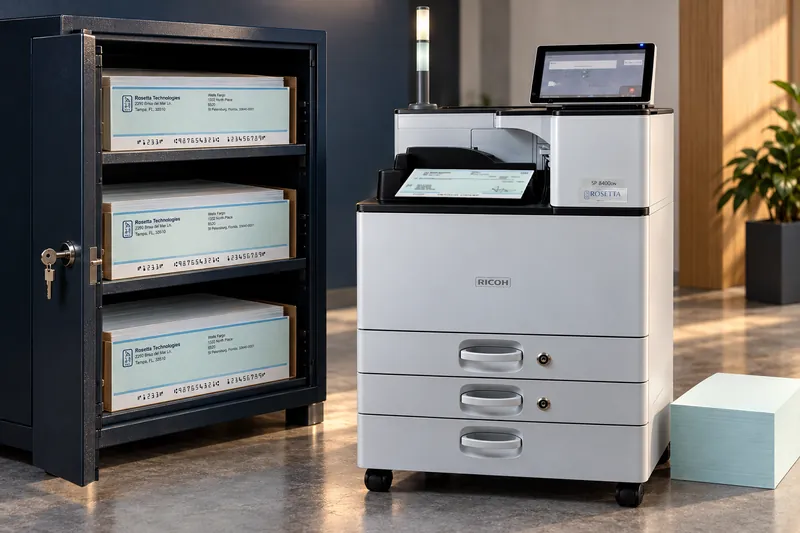
A MICR printer changes what an organization has to keep in a drawer. With pre-printed check stock, each bank account needs its own product: the background, the logo, the bank details, and often the account number are printed in advance by a supplier.
That means ordering in quantity, storing under lock and counting, destroying and reordering whenever a bank, an address, or an account number changes, and running out of the one account that needs it.
Printing on demand replaces all of it with one blank safety stock. The background, the logo, the security features, and the MICR line all print in the same pass. Changing a bank is a template change rather than an order, a shredder, and a wait.
Why print on blank stock
Pre-printed stock
One product per account
- Ordered in quantity
- Stored under lock and counted
- Obsolete when a bank, address, or account number changes
- Destroyed, and reordered
Blank safety stock
One product covers every account, each check printed on demand
- Change a template, not an inventory
- Nothing to secure beyond the blank stock
- Nothing to destroy when details change
- Never short of a specific account’s forms
There is a security argument alongside the inventory one. Blank safety stock carries no account number and no bank, so there is nothing of value sitting in storage between runs.
Where MICR turns up besides checks
Checks are the largest use, but the same technology appears anywhere a document has to be machine-read reliably after passing through the mail, a drawer, and a sorting machine.
- Official checks, cashier checks, and money orders issued by a bank
- Payroll and insurance claims payments
- Image Replacement Documents, the legal substitutes created when an item is returned
- Deposit slips and remittance documents that are sorted mechanically
Image Replacement Documents are worth a note of their own. When a check is returned, the replacement document carries its own MICR line, specific to that document. Because the line differs per item, it cannot be pre-printed. It has to be produced at the same time as the document, on blank stock, with magnetic toner.
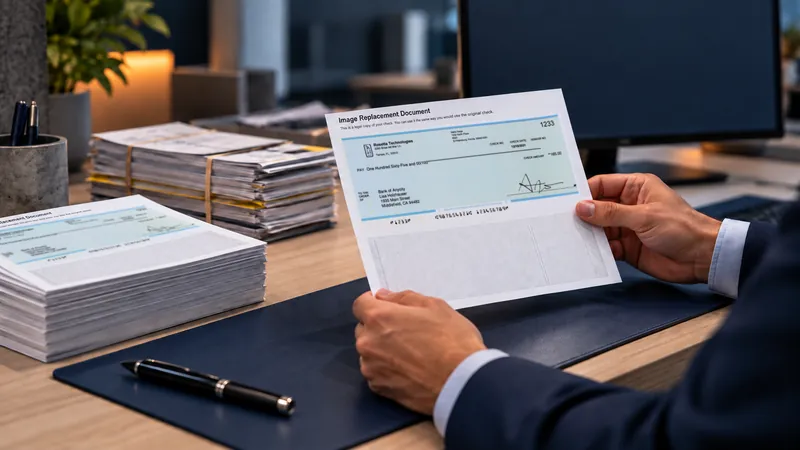
What an IRD carries
- Images of the original itemFront and back
- Its own MICR lineSpecific to this item
- ASC X9.100-140The governing specification
- Legally equivalentSubstitutes for the original
- Blank IRD stock24 lb ProMark, two-perf
Printed on demand, because the MICR line is specific to the item.
Common questions
What does MICR stand for?
MICR stands for magnetic ink character recognition. It describes both the technology and the row of characters printed along the bottom of a check, which a bank reader/sorter reads by magnetic signal rather than by the shape of the characters.
Can I print checks with a regular printer and MICR toner?
No. Magnetic toner is one of three requirements. The printer also has to be calibrated and verified on a MICR verifier so its signal strength falls inside tolerance, and it has to use certified E-13B or CMC-7 fonts tuned to that engine and that toner. Toner alone satisfies one of the three, which is why that output still gets rejected.
What is the difference between E-13B and CMC-7?
E-13B is the North American standard and uses fourteen blocky characters: ten digits and four field symbols. CMC-7 is used across much of Europe and South America and draws each character as seven vertical bars, encoding the character in the spacing between them. We supply both.
Why does a bank reject a check?
Because the reader/sorter could not read the MICR line with confidence. The usual causes are weak or uneven signal strength from the toner, a printer that is out of calibration, a font that was not built to the standard, or check stock that misses the ANSI X9.18 specification.
What is a normal MICR reject rate?
Typical MICR toner in this industry rejects at 2% to 4%. Our ProMark MICR toner is independently tested at a 0.1% reject rate or lower, on an IBM 3890 high-speed reader/sorter.
Does the paper really matter?
Yes. ANSI X9.18 specifies weight, surface smoothness, moisture content, sealed wrapping, and that the paper contain no ferromagnetic material. Stock outside that specification produces rejects on a printer that is in perfect calibration, which makes paper the most commonly missed cause when a reject rate climbs.
Talk it through with someone who builds these
We supply the printer, the software, and the toner, which is what makes the MICR Performance Guarantee possible at all. If any part of this applies to what you are trying to do, the fastest route is a conversation.