
The payment and the detail are one job
Composing the check and its remittance advice from the same data in the same pass is what stops the two being matched by hand afterwards.
A healthcare payment is rarely just a check. It arrives with remittance detail the provider has to reconcile against claims, and the two have to stay together from the printer to the envelope.
That makes this a composition problem before it is a printing one. The check and its remittance advice are one document set, produced from the same data in the same pass, on stock that carries no pre-printed account details. Volume is usually steady rather than spiky, and the deadline is a payment cycle rather than a single date.

Composing the check and its remittance advice from the same data in the same pass is what stops the two being matched by hand afterwards.
Blank safety stock carries no account number and no bank name, so there is no drawer of live check stock in a building that already has enough to protect.
Volume here is steady rather than spiky, which usually means the machine is chosen on recommended monthly volume rather than on peak speed.
A payment run that slips does not compress: the next cycle is already coming. That is what the service plan is protecting, and why response time matters more than page speed.
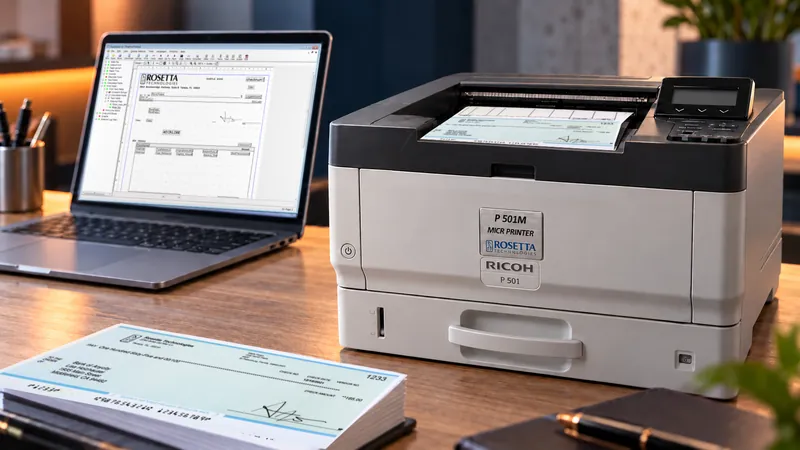
CheckStream: what gets composed, in one pass
Printed onto blank safety stock. Nothing is pre-printed. Background, logo, security features and MICR line all print at production time.
Each model below is sized to this buyer's monthly volume, with room for the peak month.
The payment, the remittance detail and the MICR line composed together onto blank stock, driven from the claims or accounting data rather than re-keyed.
Most payer operations sit in the workgroup class. A large payer running continuous cycles sits in production. The number that decides it is the monthly total, not the size of one run.
Approved supplies are one of the five conditions of the guarantee. On a document set that is already being reconciled against claims, a rejected item is expensive twice.
We cover bank fees for rejected checks over the bank's acceptable rate, where our materials caused the reject.
Five conditions apply together: a Rosetta Technologies branded printer, purchase from an authorized source, approved supplies, our MICR fonts, and continuous maintenance under an approved service plan. Mixing standard and MICR toner cartridges or photoconductor drum units is an explicit exclusion.
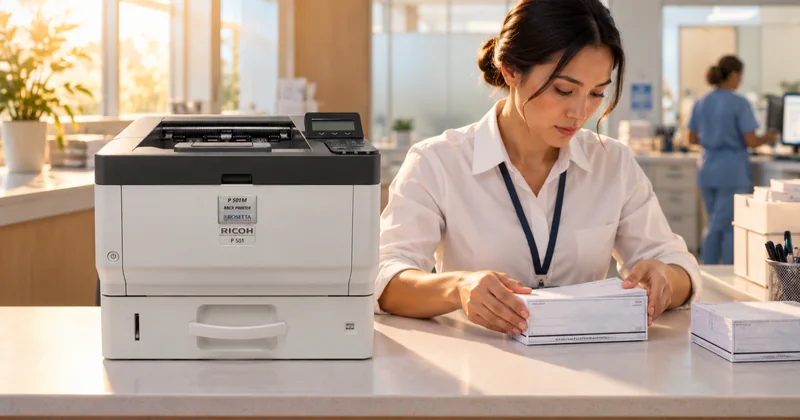
A payroll team on a run night. The date is fixed, so the reject rate matters more than the price per page.
That is a composition question and the answer depends on your document design. CheckStream composes the whole sheet, so what can share it is decided by the layout rather than by the printer.
Mechanically, no. The difference is the document: a healthcare payment usually carries detail the payee has to reconcile, which makes the composition side of the job larger than the printing side.
We supply printers, software and toner. How protected information is handled in your workflow sits with your compliance team, and we will tell you exactly what our equipment does and does not store.
It varies by payer and by cycle. Tell us the cycle and the count and we will point at a class, including when that class is smaller than you expected.
A bank is the one buyer that sits on both sides of the MICR line. It prints items that have to clear, and it receives items that have to be read, returned, and replaced. Both jobs run on a clock that does not move.
See the fitPayroll and claims work is defined by its deadline. The run is large, it happens on a date everyone already knows, and every rejected item is a person who did not get paid on the day they expected to be.
See the fitA city finance office, a school district and a university bursar are running the same job: scheduled disbursements that cannot be late, paid to people who are not set up for electronic payment, under a purchasing policy that has to be satisfied before anything is bought.
See the fitBelow a certain volume the question is not throughput. It is whether a finance team should be storing, securing, counting, and destroying pre-printed check stock for every account it holds.
See the fitA commercial printer or mailing house is not printing its own checks. It is printing other organizations' checks, which changes the problem: many accounts, many templates, other people's deadlines, and a reject that is your fault and their money.
See the fitA return item arrives as a record in a cash letter file. It leaves as a physical document that carries its own MICR line, or it does not leave at all and somebody works it by hand.
See the fitRemittance detail, an explanation of benefits, a stub the payee returns. Tell us what the document set is and we can say what composes it.