
Star
Chuck the check
Plays: A business check
Chuck is a business check with a MICR line along his bottom edge and one goal: reach the paying bank and clear.
A short animated series about how checks really work, starring Chuck the check. Every episode takes one question, answers it in about two minutes, and sends you off knowing more about the line at the bottom of every check than most people ever will.
Episode 2 now playing
Chuck the check explains why the numbers on his bottom edge are printed in magnetic ink. A bank machine reads the magnetism, not the shape, so a smudge, a stamp or a coffee ring does not get in the way.
Chuck: Here is the bottom line. My ink is magnetic, so a machine can read me even when I am smudged, stamped or written on.
Narrator: In the 1950s, banks sorted every check by hand, and the pile kept growing. Bank of America and the Stanford Research Institute set out to build a machine that could read checks. But checks arrive folded, stamped, smudged and written over. A machine that reads by sight gets confused. The answer was ink with tiny magnetic particles in it. The machine reads the magnetism, not the shape, so a coffee ring does not get in the way. Meet the MICR Crew: ten numbers and four symbols.
E-13B crew: Hello! We are the MICR line!
Sorter: Step one. Magnetize.
Narrator: Then a read head picks up the signal each character gives off. Every character has its own shape, so every one makes its own wave.
E-13B crew: Every one of us sounds different!
Sorter: Read. Every character.
Chuck: Coffee stain and all!
Narrator: The signal has to be just right: no weaker than half the standard strength, and no stronger than twice it.
E-13B crew: Can you hear me? CAN YOU HEAR ME? Just right!
Narrator: Too faint or too strong, and the check is pulled out and handled by a person. That costs time, and it can cost fees. That is why the toner matters. ProMark™ MICR toner from Rosetta Technologies is independently tested at a reject rate of one tenth of one percent or lower.
Mark: Strong, steady signal. Every character, every time.
E-13B crew: Thanks, Mark!
Narrator: That is The Bottom Line. Next time: what happens when a check will not scan?
Chuck: See you then!
Chuck the check makes his first trip through the banking system. Northside Supply writes him, Harbor Tool Company deposits him, and the payer's bank decides whether he clears.
Chuck: Here is the bottom line. A check is final when the payer's bank accepts it and pays.
Narrator: Northside Supply writes a check to pay Harbor Tool Company.
Chuck: Here I go!
Narrator: See the numbers along Chuck's bottom edge? That is the MICR line. It tells every bank which bank, which account, and which check.
Narrator: Harbor Tool Company deposits Chuck at the bank, with a teller or at an ATM.
Bank machine: Reading MICR line. Routing number, found. Account number, found.
Chuck: Say cheese!
Narrator: Now the picture travels to the payer's bank. The paper usually stays behind.
Chuck: Send me a postcard!
Bank machine: Image received. Account located. Northside Supply.
Narrator: The payer's bank checks three things. Is there enough money? Is there a stop payment? Did Northside Supply really write this check?
Chuck: Please, please, please.
Bank machine: Approved.
Narrator: The payer's bank pays, and the check is final.
Chuck: I cleared!
Narrator: If something is wrong, the check goes back fast. Money that showed up early can be taken back.
Chuck: Back I go.
Bank machine: I cannot read this.
Narrator: Every step depends on one thing: a MICR line the machine can read the first time.
Narrator: That is The Bottom Line. Next time: why is the ink magnetic?
Chuck: See you then!
Every character is a real part of how a check gets printed and paid.
Chuck is a business check with a MICR line along his bottom edge and one goal: reach the paying bank and clear.

Mark carries the iron oxide toner that gives Chuck's MICR line its magnetic signal. He joins the show in Episode 2.

The fourteen characters of the E-13B font, ten digits and four symbols. They ride along the bottom of every check, and every reader/sorter on the way reads them.
Two episodes are out, with three more coming soon.

Chuck makes his first trip through the banking system and the payer's bank decides whether he clears.
Watch now (1:51)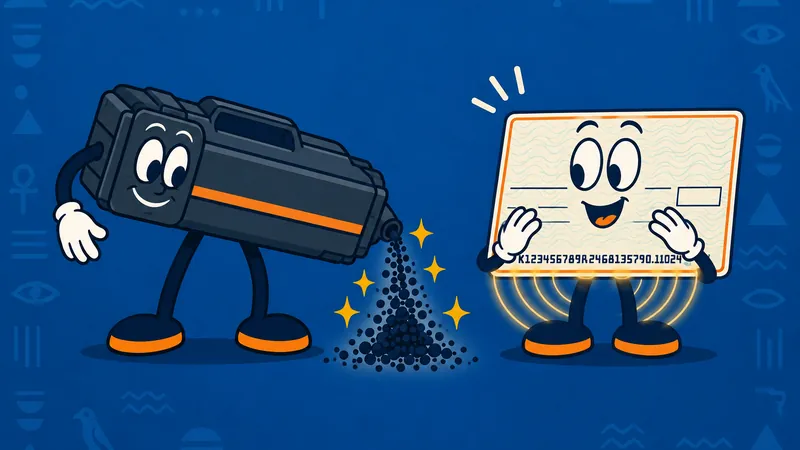
Chuck explains why his MICR line is printed in magnetic ink and how a machine reads it.
Watch now (2:09)A check the machine cannot read gets a closer look.
Coming soonA walk along the MICR line, one field at a time.
Coming soonHow a business and its bank agree on which checks are real before they are paid.
Coming soonTell us your monthly volume and what you are running now. That is enough for a real answer rather than a brochure.
Thank you. Your message is with the Rosetta Technologies team, and a member of the team will reply by email.
The form did not load. Call (800) 937-4224 or email info@rosettatechnologies.com, Monday through Friday, 8:00am to 5:00pm ET.
Required. We use this to reply to you. Nothing else. See privacy. This form is protected by reCAPTCHA; the Google Privacy Policy and Terms of Service apply.