
Smoothness affects adhesion
Toner has to fuse into the surface. A sheet outside the Sheffield range takes toner differently, and adhesion is one of the five criteria every ProMark formulation is measured against.
Paper that misses the standard will produce rejects on a printer that is otherwise in perfect calibration. These are the requirements a check stock has to meet.
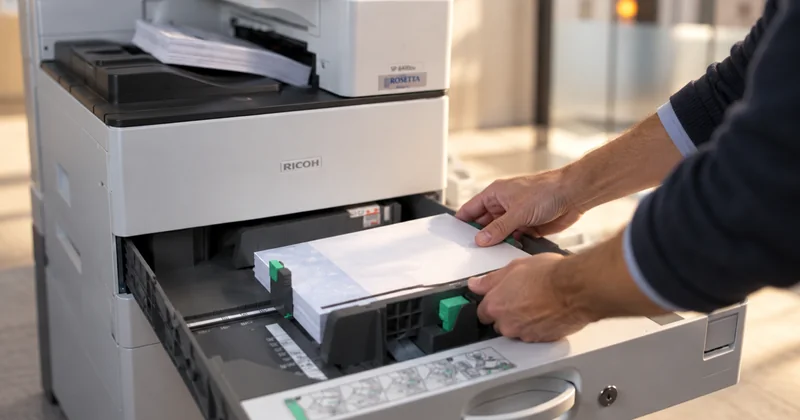
The type and quality of the paper you use is paramount to the long-term performance of your printer. Proper storage, handling, and use contribute to trouble-free operation, and the wrong stock will undo the work the toner and the calibration are doing.
Because a MICR printer prints the MICR line directly onto the paper, it runs on blank check stock. That removes the cost, inefficiency, and risk of purchasing, storing, distributing, and tracking pre-printed check stock, and it is the reason a single blank product replaces a separate pre-printed item for every bank account.

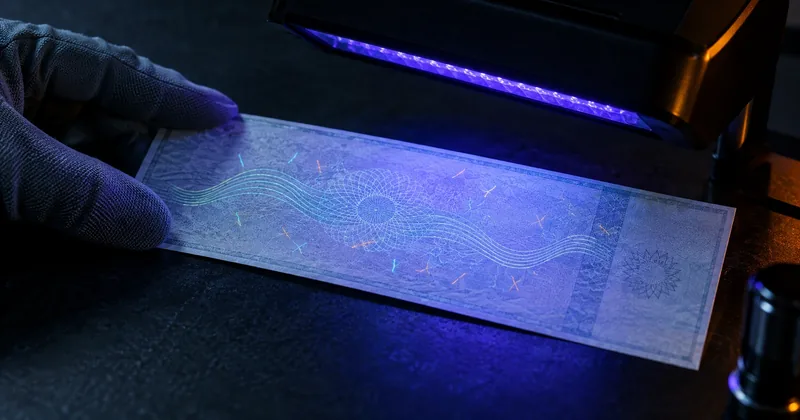
Several of the features on a security stock are only visible under a lamp, which is the point of them.
Current ANSI standard X9.18, approved by the American Bankers Association, plus the additional requirements for meeting current banking specifications.
| Weight | 24 lb, 90 g/m2, is the recommended weight |
|---|---|
| Grain direction | At 24 lb, the grain direction used for checks may be either direction |
| Sheffield smoothness | Between 120 and 150 |
| Moisture content | 4.5% |
| Wrapping | Moisture-proof package wrapping |
| Cut sheet | Avoid cut-sheet paper made from fan-fold stock |
| Ferromagnetic content | None. The paper must contain no ferromagnetic material |
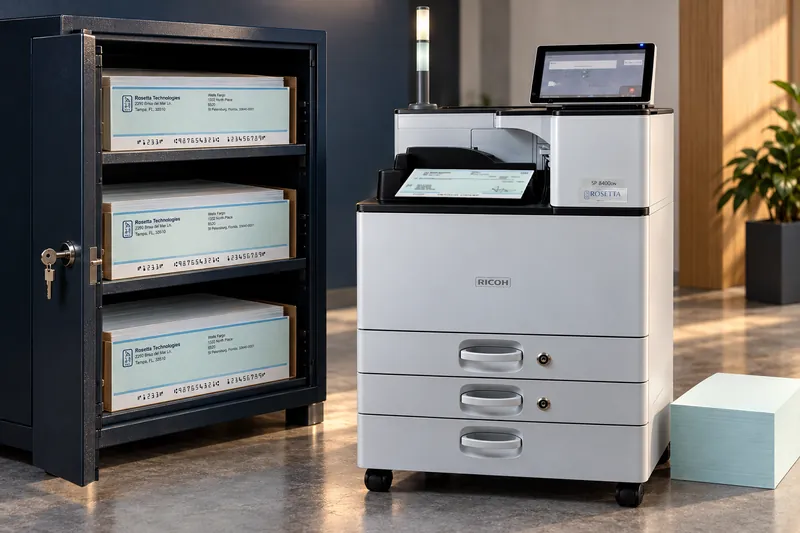
Why print on blank stock
Pre-printed stock
One product per account
Blank safety stock
One product covers every account, each check printed on demand
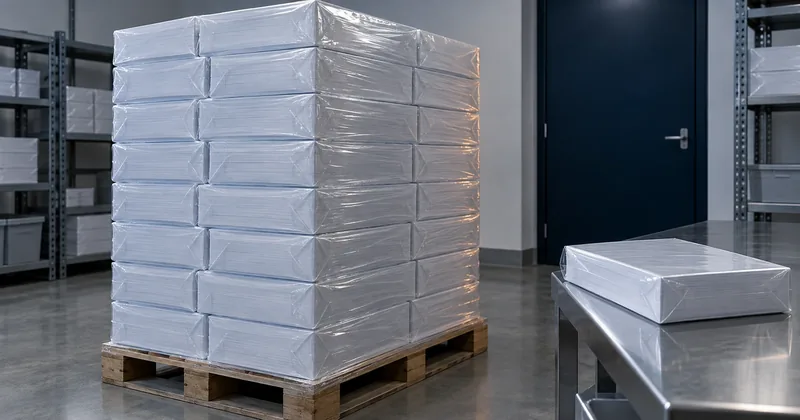
Blank stock is bought by the pallet and stored flat, because humidity changes how it feeds.
Toner has to fuse into the surface. A sheet outside the Sheffield range takes toner differently, and adhesion is one of the five criteria every ProMark formulation is measured against.
Paper at the wrong moisture content curls, feeds unevenly, and behaves differently through the fuser. Moisture-proof wrapping exists to hold the stock at specification until it is used.
A reader/sorter reads the MICR line by its magnetic signal. Magnetic material anywhere else in the sheet is noise on the same channel as the signal.
The printer line handles a wider range of media than checks alone, which matters when one device has to cover a mixed run.
An Image Replacement Document carries its own MICR line, so it cannot be pre-printed and has to be produced on a MICR printer with magnetic toner on blank IRD stock.
OnSight and OnSight Decision both ship with IRD paper stock: 200 sheets of 24 lb ProMark, two-perf. OnSight Decision splits that as 100 sheets in three-up format and 100 sheets for the merge letter.
ANSI standard X9.18, approved by the American Bankers Association, specifies 24 lb (90 g/m2) as the recommended weight. At that weight, the grain direction used for checks may run either way.
Not reliably. Check stock has to meet a Sheffield smoothness between 120 and 150, hold a moisture content of 4.5%, arrive in moisture-proof wrapping, and contain no ferromagnetic material. Ordinary office paper is not manufactured against those specifications, and paper that misses them produces rejects on a printer that is otherwise in perfect calibration.
A reader/sorter reads the MICR line by its magnetic signal. Magnetic material anywhere else in the sheet puts noise on the same channel as the signal the machine is trying to read.
An Image Replacement Document substitutes for an original check and carries its own MICR line, so it is printed on demand with magnetic toner on blank IRD stock. It cannot be pre-printed. OnSight and OnSight Decision both ship with 200 sheets of 24 lb ProMark IRD paper.
Tell us your monthly volume and what you are running now. That is enough for a real answer rather than a brochure.