
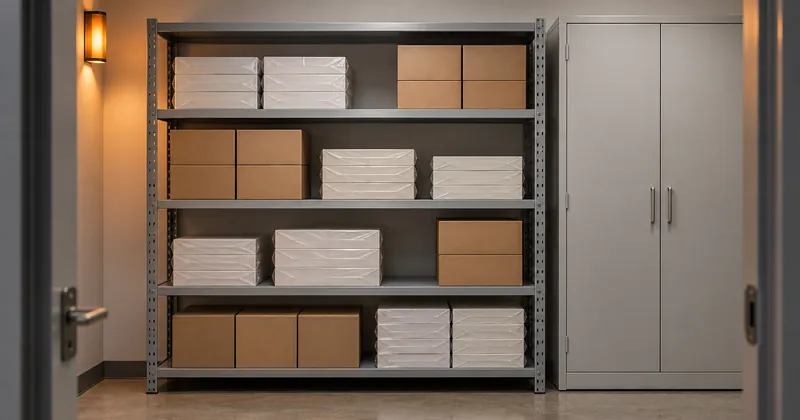
A sheet of blank safety stock carries no account number, no bank name and no MICR line. Those details exist only at the moment a check prints, so what sits in the supply cupboard between runs is paper rather than a stack of checks waiting for a payee and a signature.
That is the whole security argument for blank stock, and it is worth stating plainly because blank stock is usually filed under convenience. It is convenient: one product covers every account, and a change of bank becomes a template change. The more important change, though, is what an unauthorized person can do with the contents of the drawer. The answer moves from a great deal to very little.
What a carton of pre-printed checks gives away
Pre-printed check stock arrives from a supplier with the background, the logo, the bank details and often the account number already printed. Each sheet is a finished instrument except for the payee, the amount, the date and the signature, and those are the easiest parts of a check to add.
So a carton of pre-printed stock has to be handled the way cash is handled: ordered in quantity, stored under lock, counted, and destroyed and reordered whenever a bank, an address or an account number changes. Every account needs its own product, which means every account has its own inventory to guard. We cover the controls that inventory needs in pre-printed check stock as a security liability.
| Question | Pre-printed stock | Blank safety stock |
|---|---|---|
| What is printed before the run? | Background, logo, bank details, often the account number | Nothing specific to any account |
| How many products? | One per account | One for every account |
| What does a missing carton expose? | Forms drawn on a real account at a real bank | Paper with no account or bank on it |
| What does a change of bank do? | Makes the stock obsolete, to be destroyed and reordered | Changes a template |
| Where does the control sit? | The storeroom | The software and the printer |

Where the control goes instead
Blank stock does not remove the need for control. It moves it. When the account details, the bank block and the MICR line are printed on demand, the valuable thing in the building is no longer the paper. It is the ability to print: access to the check printing software, the templates that hold each account, and the MICR printer that produces the line.
That is a smaller thing to protect, and a more manageable one. A carton can be carried out of a building without anyone noticing for weeks. A right to print is a setting that can be granted to named people, recorded and withdrawn. CheckStream® LS, Office and Pro include user-level security and reprint security as standard, so who may print a check, and who may print the same check again, is decided in the software rather than by whoever holds the cupboard key. We go through those settings in user-level security and reprint security.
The printed security features move as well. VOID pantograph, microprint, watermarks imprinted into the background and Eurion dot security are composed onto the sheet in the same pass as the MICR line, so a security feature becomes a configuration choice rather than something bought in advance and stored. Our check printing software prints all four.
What blank stock still needs
Blank safety stock is not worthless to a thief, only far less useful. It is still check paper, and it should be handled as a controlled supply. The handling rules we publish are short:
- Store check stock in locked facilities, even when it is blank.
- Verify box integrity on receipt, before a carton goes onto the shelf.
- Buy blank safety check stock from established suppliers rather than on price alone.
- Print on demand rather than holding any pre-printed inventory, so a change of bank, address or account number creates no stock to destroy.
The paper also has to meet ANSI X9.18 (opens in a new tab) for the MICR line to read: 24 lb recommended, Sheffield smoothness between 120 and 150, moisture content of 4.5%, moisture-proof wrapping and no ferromagnetic material. Our check stock page sets out each requirement. A locked, dry storeroom serves both purposes at once, because sealed wrapping kept in a controlled room is also how stock stays inside its moisture specification.
What blank stock does not stop
It is worth being exact about the limits, because blank stock is sometimes described as if it ended check fraud. It does not, and treating it that way leaves real gaps open.
- It does not stop a person with print rights from printing a check they should not. That is an access and approval question, handled in the software and in how duties are divided.
- It does not stop a genuine check from being altered after it leaves the building. Alteration is addressed by printed features and by bank services such as positive pay.
- It does not stop a counterfeit made elsewhere from a copy of one of your checks. Printed features make copying harder, and positive pay at your bank checks presented items against the issue file you actually sent.
- It does not protect the payment data on its way from the accounting system to the printer. That path needs controls of its own.
What it does stop is the quiet loss nobody notices: a few sheets taken from the back of a carton that is only counted once a quarter. With blank stock, nothing in that carton names your bank.
The changeover is the exposed moment
The point of greatest exposure is the move itself, when the new process is running and the old pre-printed stock is still in the building. Count what remains, destroy it under the same controls you apply to spoiled checks, and record that you did. The rest of the move, from stock specification to the first verified run, is in printing checks on blank safety stock, start to finish.
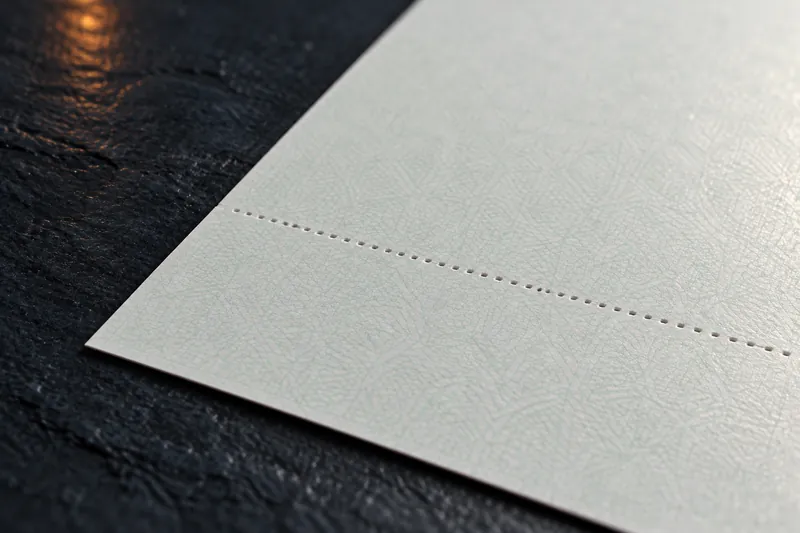
Blank safety stock can carry security features of its own, some visible only under a lamp. Ask your stock supplier which features a given stock includes, since those are properties of the paper rather than of the printing.