
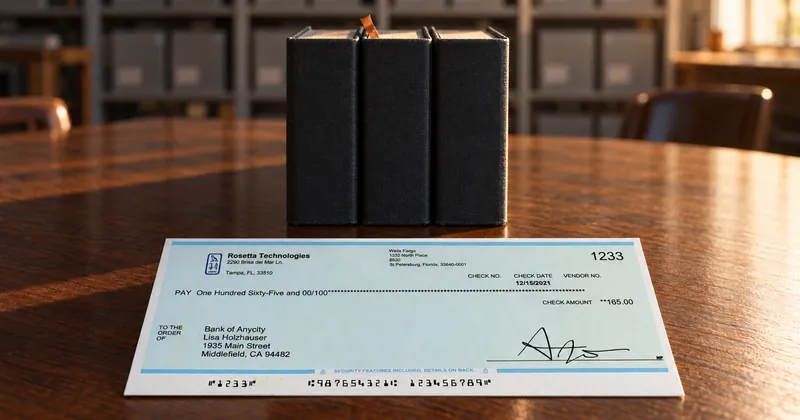
Three organizations stand behind the standards a check is printed to. The American Bankers Association and the American National Standards Institute establish the MICR specifications, and the Accredited Standards Committee X9 Financial Services publishes the American National Standards for check documents and reviews them periodically. Your bank then sets rules of its own on top, which is why a check printer has to answer to all of them at once.
Most finance teams meet these names as initials on a datasheet: ABA, ANSI, ASC X9. Side by side they read like one authority. They are not, and knowing which one decides what saves time when a bank questions your output, when a supplier claims compliance, or when an auditor asks what your checks are printed to.
Three names behind one line of characters
The American Bankers Association is the authority behind the routing number system, the nine digits that the transit field of the MICR line carries. It also approved ANSI X9.18, the standard for check stock.
The American National Standards Institute is the second name on the MICR specifications. The standards a check printer works to carry its initials: ANSI X9.18 for the paper, ANSI X9.100-160-1 for magnetic ink printing, ANSI X9.100-20 for print and test specifications for magnetic ink printing, and ANSI X9.100-140 for the Image Replacement Document.
ASC X9 is where those documents live. It publishes the American National Standards that specify check documents and the MICR line on them, and it reviews them periodically, so a standard is a maintained document rather than a fixed one. It works through committees, and we sit on one of them, which we explain in what the X9B committee on paper payment systems works on.
| Organization | Its role | Where a check printer meets it |
|---|---|---|
| American Bankers Association | Sets MICR specifications with ANSI, stands behind the routing number system, and approved ANSI X9.18 | The transit field and the check stock specification |
| American National Standards Institute | Sets MICR specifications with the ABA | Every standard named ANSI X9, from paper to IRDs |
| ASC X9 Financial Services | Publishes the standards for check documents and the MICR line, and reviews them periodically | The documents a compliance claim should point to |
| Your bank | Sets its on-us field layout, its acceptable reject rate and its fees | Sample approval and the reject report |

The layer above the standards: the law
Standards describe how a check is made. The law decides whether it counts. The federal rules on check processing have been revised over time, but one requirement has not changed: checks and substitute checks need a magnetic code line to be treated as cash items for processing in the United States payment system.
The Check 21 Act, a federal law signed in 2003 (opens in a new tab) and effective in 2004 (opens in a new tab), sits in the same layer. It lets a properly prepared substitute check serve as the legal equivalent of the original, and the standard for how that substitute is prepared is ANSI X9.100-140. We explain these topics generally. Where a decision depends on the law, the people to ask are your bank and your counsel.
The layer below the standards: your bank
Standards stop short of some decisions, and the issuing bank makes them. The internal layout of the on-us field is set by the bank rather than by the standard, so two banks can lay out the same account information differently and both be correct. Each bank also sets its own acceptable reject rate and charges for rejected items at its own fee schedule.
That is why a printed sample sent to the bank before a first live run is routine rather than a formality. We go through how the two layers meet in where the standards stop and your bank's rules begin.
Why a check printer follows all of them
A reader/sorter does not know which body wrote which requirement. It reads the line by its magnetic signal, and an item clears only when the paper, the characters, the signal and the layout are all right together. ANSI requires signal strength between 50 and 200 percent of nominal (opens in a new tab), and the stock under the line has its own specification in ANSI X9.18. Either one missed is a reject, whatever the rest of the item looks like.
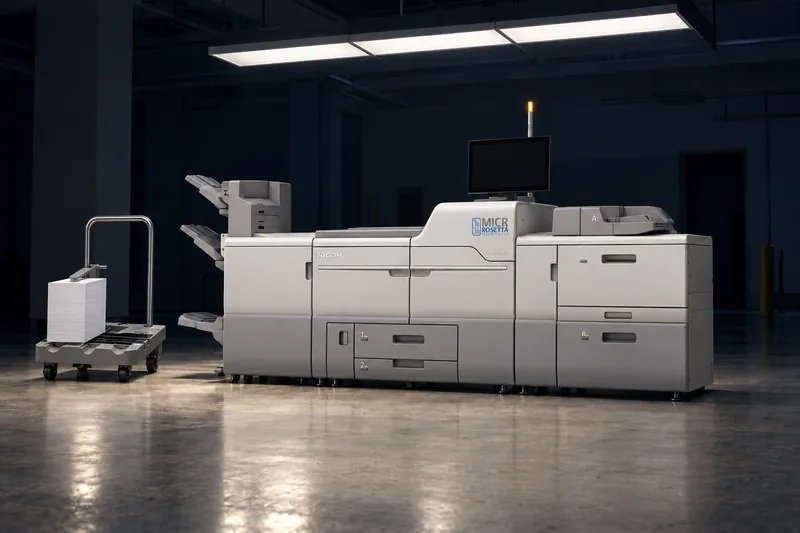
Our printers produce output that complies with the ASC X9 and ABA specifications, using E-13B and CMC-7 fonts we certify and tune to each engine and its toner. On a production printer, our installation and MICR certification tests all output elements against ANSI specifications on a check verifier before your operators run a live job.
Who to ask when a question comes up
- About the paper: name ANSI X9.18 and ask your stock supplier to confirm conformance in writing. Our check stock page lists the requirements it sets.
- About the MICR line: ask which standard a compliance claim refers to and what the output was tested against. The MICR line on a check sets out each field.
- About the on-us layout or the acceptable reject rate: ask your bank, since both are the bank's decision.
- About whether an item counts as a cash item, or how a substitute check stands legally: ask your bank or your counsel.
- About the full text of a standard: get it from ASC X9.
We name the standard wherever one decides the answer, so you can take the question to your bank rather than take our word for it. A supplier who cannot name the document behind a compliance claim is asking you to take theirs.
Checks drawn on Canadian accounts answer to Payments Canada (opens in a new tab), formerly the Canadian Payments Association. Several of our printers carry a guarantee written against the acceptance standards of ANSI, the ABA and the Canadian Payments Association.