

X9B is the committee of the Accredited Standards Committee X9 named for paper payment systems, the payments that travel as a physical item and are read by a machine, and we are a standing member of it. For you, that means the company behind your printer, toner and fonts takes part in the standards work on paper payments. It does not mean our word replaces the standard or your bank.
ASC X9 Financial Services publishes the American National Standards that specify check documents and the MICR line on them, and it reviews those standards periodically. The work is divided among committees. X9B carries the name Committee on Paper Payment Systems, and the name describes its territory well enough to start with.
What paper payment systems covers
A paper payment is an object before it is a transaction. Someone has to make the sheet, print magnetic characters on it, read those characters at speed, and sometimes turn an image of the item back into paper. Standards touch each of those steps. The ones we name across this site all carry the X9 designation, and they fall into four groups:
- The sheet: ANSI X9.18 (opens in a new tab), approved by the American Bankers Association, which sets the requirements for check stock, from weight and smoothness to the absence of ferromagnetic material.
- The magnetic characters: ANSI X9.100-160-1, Magnetic Ink Printing (MICR), and ANSI X9.100-20, Print and Test Specifications for Magnetic Ink Printing (MICR).
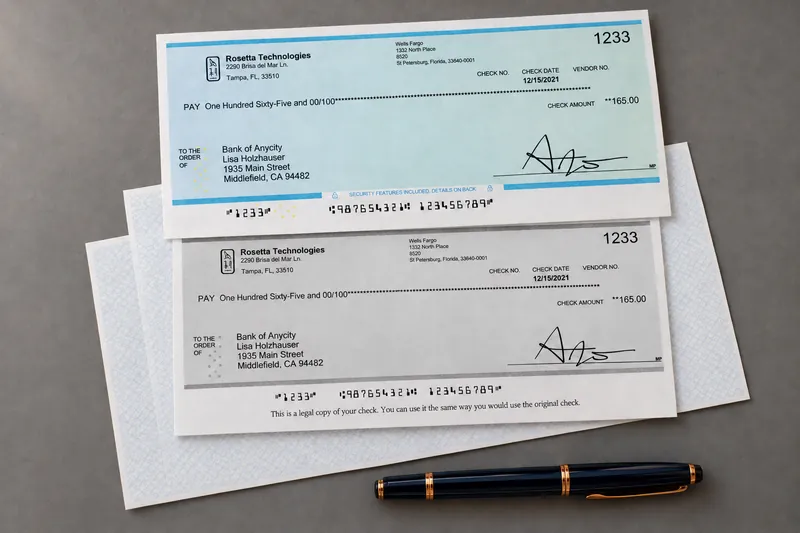
- The substitute item: ANSI X9.100-140, the standard for the Image Replacement Document, the paper substitute printed from the image of an original check.
- The file between them: the X9.37, X9.100-180 and X9.100-187 cash letter formats, which carry check images and data electronically.
Which committee maintains which of those documents is a question ASC X9 can answer directly, and we would rather point you there than guess. What the documents share is a subject: the check as a physical item that a machine has to read correctly the first time.
That subject needs agreed rules because a paper item passes through many hands that never meet. The organization that prints a check, the bank that takes the deposit, the bank it is drawn on and any processor in between all depend on the same physical properties of the same sheet. None of them can inspect the others' equipment, so the standard is the only place they can all agree on what a readable item is.
Why a printer maker sits on a standards committee
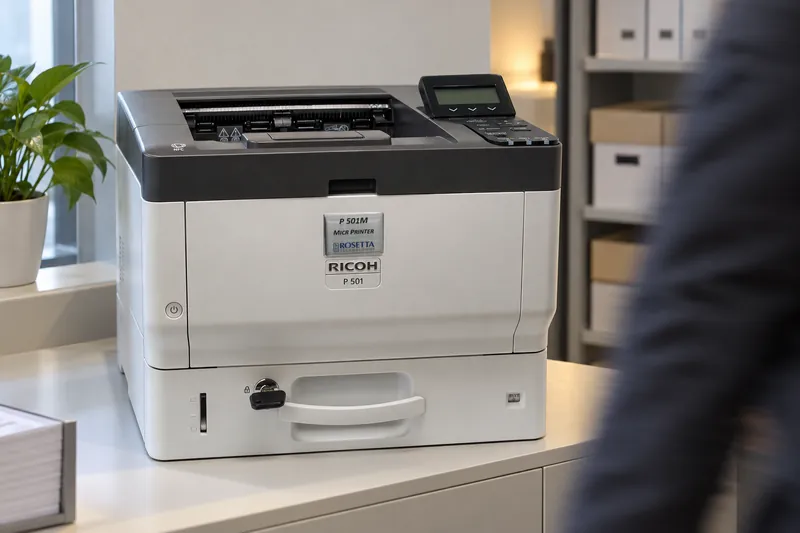
Everything we build is measured against these documents. Our printers produce output that complies with the ASC X9 and ABA specifications. ProMark™ MICR toner is formulated to deliver the signal strength, optical density, adhesion, cohesion and yield that ANSI and bank specifications require. Our E-13B and CMC-7 fonts are certified and tuned to each engine and its toner.
A standard that is reviewed periodically is a maintained document, not a fixed one. Sitting on the committee for paper payment systems keeps us close to that work instead of learning about it after the fact. We have worked in magnetic ink character recognition since the company was founded, and standing membership is part of how we keep that work tied to the documents it is judged by.
What it means for you
- Claims that point to a document. Our datasheets say what the output complies with, by name. Ask for the standard behind any claim, ours included, and expect a specific answer.
- Verification before shipping. Every printer we ship has its own sample checks measured on a MICR verifier before it leaves us.
- Certification on your floor. On a production printer, installation includes testing all output elements against ANSI specifications before your operators run a live job.
- A guarantee on the outcome. The MICR Performance Guarantee pays bank fees for rejected checks above your bank's acceptable rate where our materials caused the reject, under five conditions that apply together.
What membership does not change
Membership does not make us the authority on your checks. The standard is the authority on what it says, and your bank is the authority on what it accepts: it sets the layout of the on-us field, its acceptable reject rate and its fees. A seat on a committee changes none of that, and it is not a certification of any single printer either.
Nor does it replace a measurement of your own output. If you want to know where your checks stand, a document evaluation measures samples of what you actually print. That result applies to your checks, which a committee seat never can.
Following the work yourself
Most finance and operations teams never need to read a standard end to end. What they need is to know which document governs which part of the check, and who to ask when a requirement changes. We cover the first in who writes the standards for checks. For the second, your bank can tell you which of its requirements come from a standard and which are its own, and if you want to know whether a revision touches the equipment or supplies you run, ask us.