
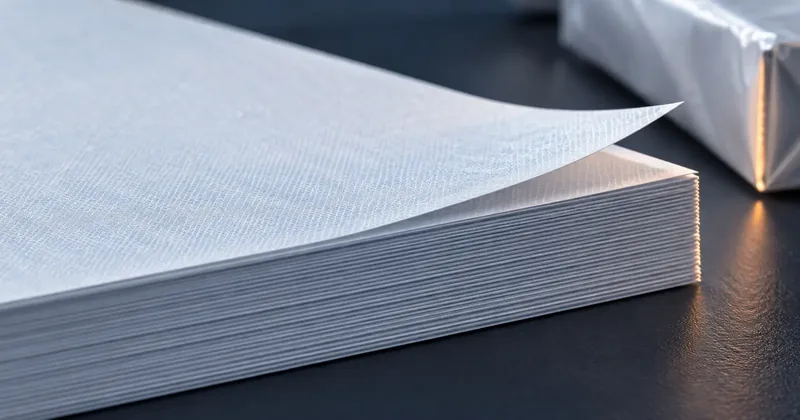

Paper is the part of a check printing operation that people treat as a commodity. It arrives on a pallet, it goes in a store room, and somebody reorders it when the store room looks empty. Meanwhile the specification that governs it is doing real work, and every one of its requirements exists because something went wrong without it.
ANSI X9.18 is that specification. It governs check stock, and it is approved by the American Bankers Association. If you buy paper for check printing, it is the document your supplier should be able to speak to without hesitation.
The five requirements
| Requirement | The specification | Why it is there |
|---|---|---|
| Weight | 24 lb recommended | Stiffness and handling through feed paths and reader/sorters |
| Sheffield smoothness | 120 to 150 | Surface consistency, which affects how toner lands and adheres |
| Moisture content | 4.5% | Dimensional stability and behavior through the fuser |
| Wrapping | Sealed and moisture-proof | Keeps the moisture content where the specification put it |
| Magnetic content | No ferromagnetic material | The read head cannot separate paper magnetism from ink magnetism |
The first four are familiar to anyone who has bought paper for a demanding print process. The fifth is specific to this work, and it is the one that gets overlooked.
The requirement almost nobody asks about
Check paper must contain no ferromagnetic material. The reason is straightforward once you know how the read works: the reader/sorter magnetizes what is on the line and measures the resulting signal. It has no way to ask whether a given contribution to that signal came from toner or from something in the sheet.
Ferromagnetic content in the paper adds to what the head sees. It does not matter that the addition is small or that it is spread evenly. It is noise inside a measurement that is being compared against a tolerance, and it consumes margin that the printing process needs.
This is a question to put to a paper supplier in writing. It is not an unusual request, and a supplier who sells stock for check printing should answer it immediately.
Smoothness and moisture are not decorative
Sheffield smoothness of 120 to 150 describes a surface that is even enough for toner to lay down consistently, without being so slick that it causes handling problems. Toner coverage is part of what determines signal strength, so surface consistency is part of the MICR question, not just a print-quality question.
Moisture content of 4.5% is the specification, and it is the requirement most often lost after delivery rather than at purchase. Paper exchanges moisture with the air around it. A box opened in a humid store room and left half used does not stay at 4.5%, which is exactly why the standard also requires sealed moisture-proof wrapping.
Read those two together and the storage rule writes itself. The wrapping is part of the specification, so leaving stock unwrapped is a specification failure in slow motion rather than an act of tidiness.
How to use the standard when buying
You do not need to become an expert in paper to buy well. You need to ask a short, specific set of questions and to expect specific answers.
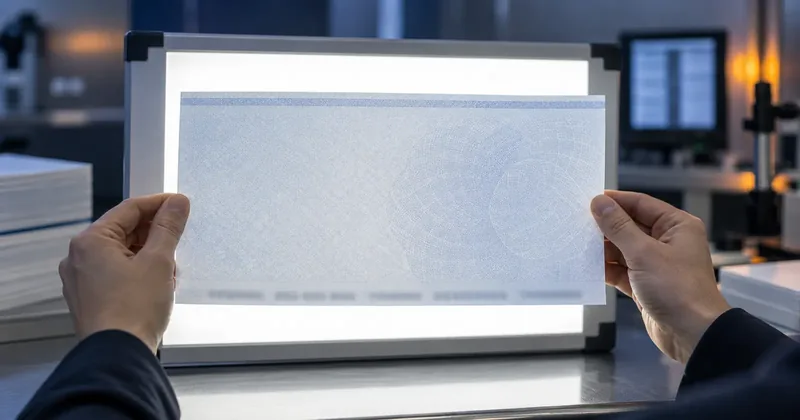
- Does this stock conform to ANSI X9.18, and can you state that in writing?
- What is the basis weight, and is it the recommended 24 lb?
- What Sheffield smoothness does this stock hold?
- Is the stock certified free of ferromagnetic material?
- How is it wrapped, and is the wrapping moisture-proof and sealed?
A supplier who can answer those five questions is selling check stock. A supplier who treats them as unusual is selling paper and letting you find out the difference at the bank.
The cost of getting this wrong does not appear on the paper invoice. It appears later, as items that leave straight-through processing and get handled by a person at the bank, at the fee your bank charges for that handling.
Why weight is a specification and not a preference
The recommended 24 lb weight is about handling rather than appearance. A check moves through your printer's feed path, through envelope inserting, through the mail, and then through a reader/sorter at speed. Each of those stages assumes a sheet with a certain stiffness.
Lighter stock is more likely to misfeed, to skew, and to arrive at the read head in a condition the read was not designed for. Heavier stock brings its own handling behavior. The recommendation exists because somebody has already worked out where the compromise sits, and there is little to gain from relitigating it on your own equipment.
Skew is worth dwelling on, because it connects paper handling to the measurement. A MICR line that does not pass under the read head the way the specification assumes is a line whose characters are being read under conditions the standard did not describe. Stiffness is part of what keeps that from happening.
The specification does not stop at delivery
Weight and smoothness are fixed at the mill. Moisture content is not. It is a property the paper holds only as long as its environment lets it, which is why the wrapping requirement sits in the same standard as the moisture requirement.
The practical implication is that a store room is part of your compliance with ANSI X9.18. Stock that arrives conforming and is then stored badly is stock that stopped conforming inside your building, and nothing about the box will tell you when it happened.
Our advice is to open cases only as runs need them, to keep stock off the floor and away from exterior doors and loading bays, and to treat a long-open partial case as suspect rather than as convenient. If in doubt, run a sample and verify it on a MICR verifier before committing it to a payment run.
ANSI X9.18 is the governing document. Where a bank imposes additional requirements of its own, those apply on top of the standard rather than instead of it.