
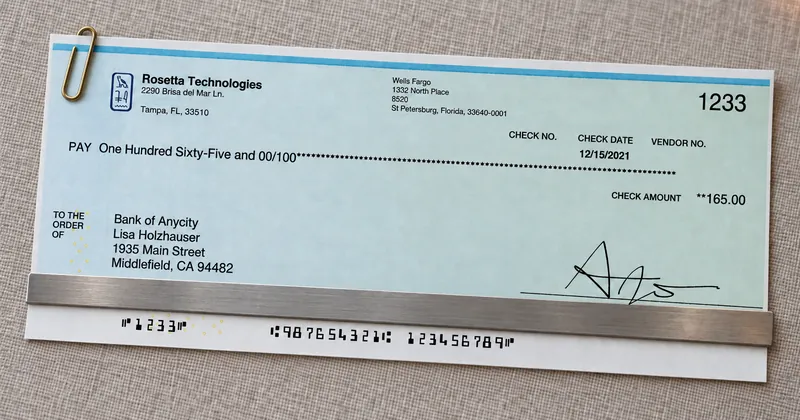
The four E-13B symbols are the punctuation of the MICR line. Transit brackets the routing number, Amount brackets the amount, On-Us marks off the account portion, and Dash breaks up digits inside a field. None of them carries a value. Each one tells the reader/sorter which field it is in.
A row of digits with no punctuation is ambiguous to a machine. Is the next character the last digit of the account number or the first digit of the routing number? E-13B answers that question with four symbols (opens in a new tab), and the reader/sorter depends on them more than most people who print checks realize. We cover the full character set in the fourteen E-13B characters and what each one is for. This post stays with the four that carry no value at all, and with the practical question of which ones your printer is responsible for.
Walking the line in the standard's direction
Positions on the MICR line are numbered from right to left, starting at position 1 at the far right edge of the document. That is the opposite of how a person reads, and it is the convention specifications and reader/sorter messages use. If your bank ever describes a problem by position, it will count from the right, so it is worth learning the line in that order.
- The amount field, at the far right. Bracketed by Amount symbols. On a normal business check this end of the line is blank when the check leaves your printer, because the amount is encoded after the check is written, usually by the bank of first deposit.
- The on-us field. The account number, and on many checks the check serial number as well, marked off by an On-Us symbol. Its internal layout belongs to the issuing bank rather than to the standard.
- The routing number. Nine digits with a Transit symbol on each side. The ninth digit is a check digit calculated from the first eight.
- The auxiliary on-us field, at the far left. Present mainly on business-size checks, most often carrying the check serial number, and bounded by On-Us symbols when it appears.
Seen this way, the symbols are the fixed points and the digits are what sits between them. The machine does not need to count characters to know which field it is in. It needs the symbols to be where the layout says they are, and it needs each one to produce the waveform that identifies it.
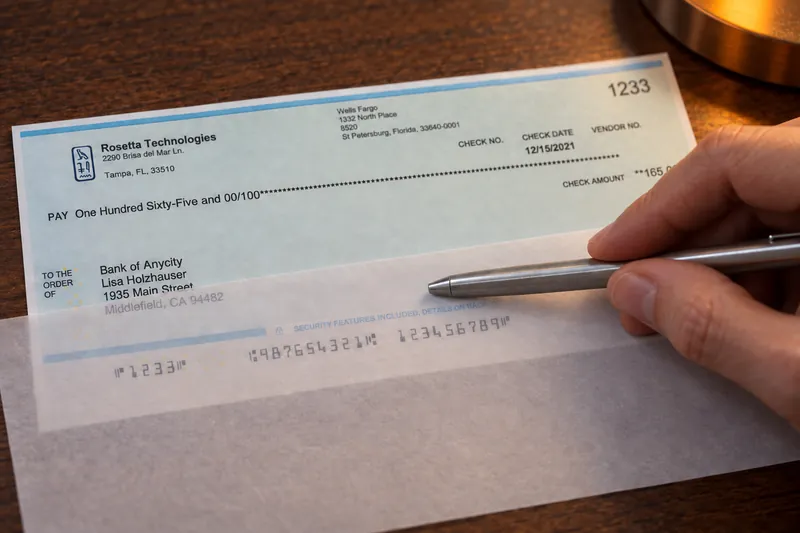
Transit and Amount: the two the standard fixes
Transit is the symbol with the most riding on it. It brackets the routing number on both sides, so the reader/sorter knows the nine digits between them identify the institution the item is drawn on. That field decides where the item goes. Together with the check digit, the brackets give the machine two separate ways to trust the field: the symbols say where it starts and stops, and the ninth digit says whether the eight before it were read correctly. That is why a routing problem often shows up as a rejected item rather than a misrouted one.
Amount is the symbol a check printer usually does not print. Since a bank encodes this end of the line after the check is written, the check writer leaves it blank, symbols included. For anyone laying out a check, the Amount symbol is less a character to produce than a space to protect. A background pattern, a border, or a line of text that drifts into the right end of the band sits exactly where the bank will encode, and anything magnetic printed in the band becomes part of the signal the read head sees.
On-Us and Dash: the two your bank decides
On-Us marks off the account portion of the line, but its exact use varies between issuing banks, and so does the internal layout of the on-us field it belongs to. Two banks can lay out the same account information differently, and both are correct. We go further into that field in what the on-us field carries and why its layout varies by bank.
Dash is a separator used inside a field, most often within an account number. Whether your account number carries one, and where, is a question of how your bank formats it. Nothing about the standard will tell you.
This is the practical reason check printing software is configured per account rather than once per company. CheckStream® supports multiple bank accounts, and each account's line has to follow its own bank's layout for these two symbols.
| Symbol | Placement decided by | Printed when the check is printed? |
|---|---|---|
| Transit | The standard: one on each side of the nine-digit routing number | Yes |
| Amount | The standard places the field at the far right; the bank of first deposit usually fills it | Normally no. That end of the band is left blank |
| On-Us | The issuing bank's layout for the account portion of the line | Yes, where the bank's layout calls for it |
| Dash | The issuing bank's account number format | Only if that format uses one |
What goes wrong when a symbol is wrong
Lose a digit and the reader/sorter loses one character. Lose a symbol and it can lose the boundary of a whole field. The ways that happens are few, and most of them are preventable before the first live run.

- A symbol drawn by a font that resembles E-13B but was not built to it. It looks right on the page and produces the wrong waveform, so the machine cannot tell which symbol it met.
- A symbol printed with too little magnetic signal. The symbols are printed in the same toner as the digits, so a weak line weakens them too.
- An On-Us symbol or Dash placed where your bank's layout does not expect it. The characters are perfect and the field is still wrong.
- Printing at the right end of the band, where the Amount symbols and the amount will be encoded.
- Physical damage across a symbol: a fold, a staple hole, a tear or a stamp.
Whichever of these causes it, the result at the bank is the same. The item drops out of straight-through processing and is handled by a person, at a fee the bank sets. The MICR line on a check, field by field covers the other causes of a misread line, from stock to registration.