
What makes a printer a MICR printer
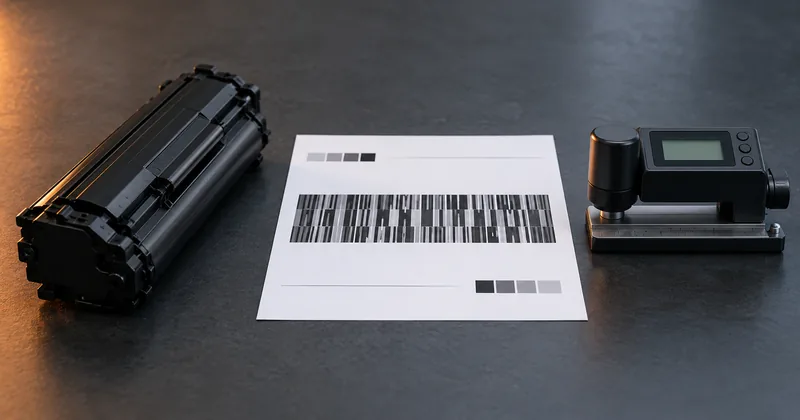
- Magnetic tonerIron oxide gives the characters a magnetic signature.
- CalibrationProduction verified on a MICR verifier before it ships.
- Certified fontsE-13B or CMC-7, tuned to the engine and the toner.
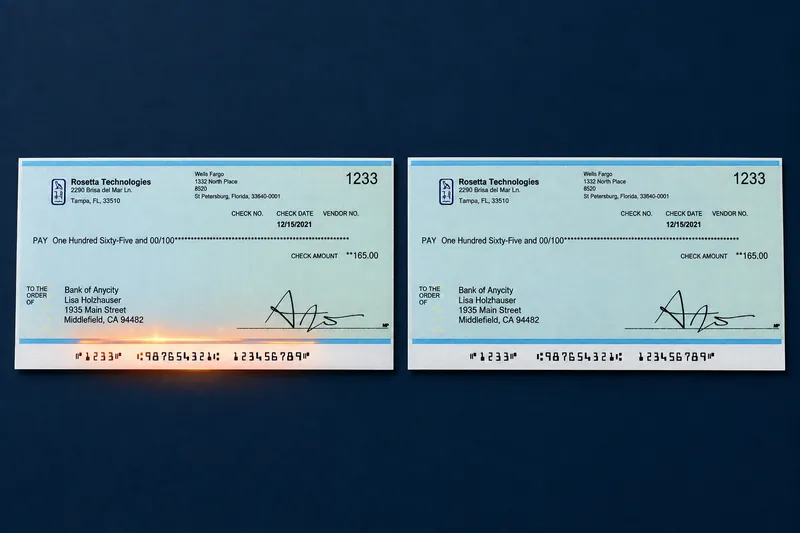
All three present, and the item clears. The reader/sorter reads the line. With only the toner, the check looks right to a person and is rejected by the machine.
Three things make a printer MICR capable, and all three are necessary. Only one of them can be confirmed by looking at the machine.
That asymmetry explains most of the trouble in this category. The requirement that is easy to check is the one buyers check, and the two that are hard to check are the ones that quietly are not met.
The three requirements
| Requirement | What it is | Can you inspect it? |
|---|---|---|
| Magnetic toner | Toner containing iron oxide, which is why magnetic toner is black, giving the read head something to detect | Yes. Read the cartridge and the specification. |
| Calibration verified on a MICR verifier | A measurement of what the assembled machine actually produces, compared against the standard | No. It is a record held by whoever performed it. |
| Certified E-13B or CMC-7 fonts | Fonts tuned to that specific engine and toner, so that the printed characters produce the expected waveform | No. The output looks identical either way. |
Why the toner alone is not the answer
Magnetic toner is necessary and it is not sufficient. Signal strength is a property of the assembled machine, not of the toner alone. The engine, the fuser temperature, the transfer roller, and the toner all contribute to how much magnetic material ends up on the page and in what distribution.
This is why we formulate our own toner per print engine rather than selling one universal product, and why we re-engineer proven Ricoh print engines into MICR capable hardware rather than manufacturing proprietary printers. The toner is developed against a known engine, and the engine is known because we did the conversion.
ProMark™ MICR toner is independently tested at a 0.1% reject rate or lower on an IBM 3890 high-speed reader/sorter. For comparison, typical MICR toner in this industry rejects at 2% to 4%. On a hundred thousand checks a year, that difference is the distance between a hundred exceptions and two to four thousand of them, each one leaving straight-through processing to be handled by a person at the bank and charged at the bank's own fee schedule.
The two you cannot see
Calibration is a measurement of a specific assembled machine. It is performed on a MICR verifier, and the result is a number that falls inside or outside the band the standard defines. Nothing about the printed page tells you where in that band the machine sits, which is why a page can look flawless and still read weakly.
Font certification is the same kind of invisible. E-13B characters carry deliberately uneven ink mass distribution, and that distribution is what produces a distinct waveform per character when a reader/sorter magnetizes the ink and passes it under a read head. A font can draw characters at correct dimensions and still deposit ink in a distribution that reads marginally on a particular engine. Certification to that engine and that toner is what closes that gap, and there is no way to confirm it from the output.
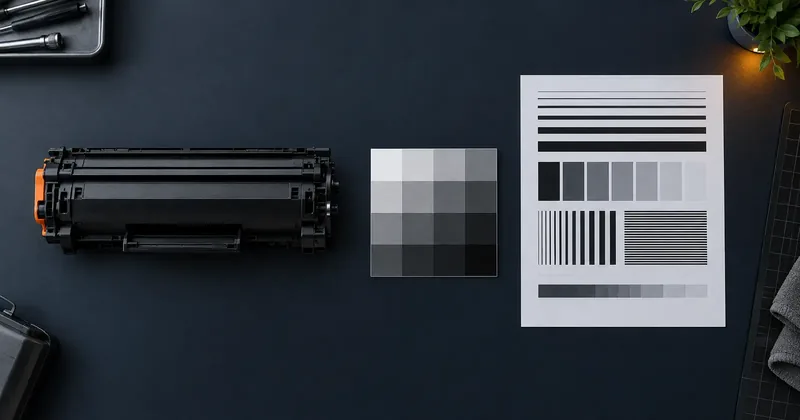
There is one more thing worth saying about the two invisible requirements: neither of them stays settled. Calibration describes a machine at a moment, and the machine keeps running. Font certification describes a pairing, and the pairing changes the first time somebody substitutes a cartridge. Both are conditions to be maintained rather than boxes checked at install, which is exactly why they need to be asked about rather than assumed.
What to ask, since you cannot look
- Was calibration verified before shipment, and can I have the record? If verification happened, a record exists. If no record exists, treat that as the answer.
- Are the fonts certified to this engine and this toner? Not certified in general. Certified to the specific combination you are buying.
- Is calibration re-verified after service? A maintenance kit replaces the fuser, photoconductor drum, transfer roller, pickup rollers, and separation pads. Two of those are direct contributors to signal strength, so the calibration that held before the kit went in should not be assumed afterward.
- Is the toner formulated for this engine? A universal magnetic toner is a toner formulated for no engine in particular.
- What happens if items reject at the bank? Ask what is offered and what conditions attach. Our MICR Quality Guarantee is written against acceptance standards set by the American Bankers Association and the Canadian Payments Association, and like any guarantee in this category it carries conditions worth reading before you need them.
Where this shows up at volume
The consequences scale with the run. On a high-volume device such as the Pro 8310M or Pro 8320M, running at 111 or 136 pages per minute with a recommended monthly volume of up to a million impressions, a fractional difference in reject rate is thousands of items a year. Those machines print at 1,200 x 4,800 dpi via VCSEL and support up to eight media pick points and 12,600 sheets, which is the kind of specification that makes it into a comparison.
Volume also multiplies the cost of getting the invisible requirements wrong. At 136 pages per minute, a configuration problem produces a large number of unreadable items before anybody has finished reading the first complaint. The controls that matter at that scale are the ones applied before the run: verified calibration, fonts certified to that engine and toner, and toner formulated for that engine rather than for magnetic printing in general.
None of those figures tell you what the device will measure on a verifier. That is the point. The specification sheet describes the engine, and the MICR behavior comes from what was done to the engine afterward. Ask about the two requirements you cannot see, because they are the ones that decide what your bank statement looks like.