
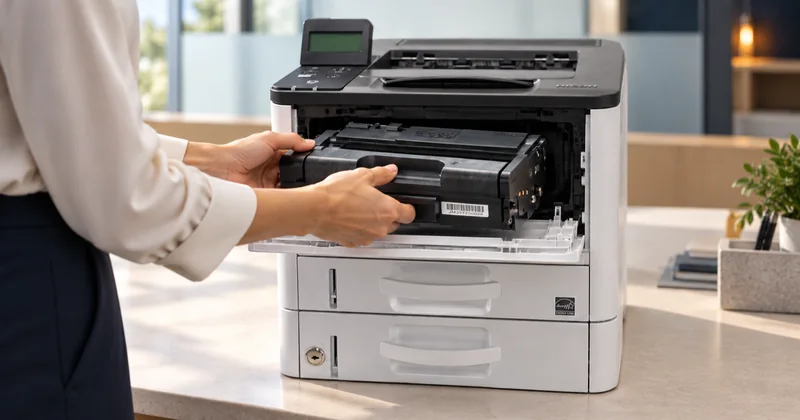
Start with monthly volume, not speed
Pages per minute is the number every vendor leads with, because it is the easiest to compare and the most flattering. It decides how long a run takes. It does not decide whether the machine survives the workload.
Recommended monthly volume is the number that matters. It is the manufacturer's statement of what the machine is built to do month after month. Above it, parts wear faster, and as parts wear, MICR signal strength drifts toward the edge of tolerance.
Maximum duty cycle is a third number, and it is the one most often misused. It describes an upper limit, not a sustainable workload. A machine with a 300,000 page duty cycle and a 53,000 page recommended volume is a 53,000 page machine.
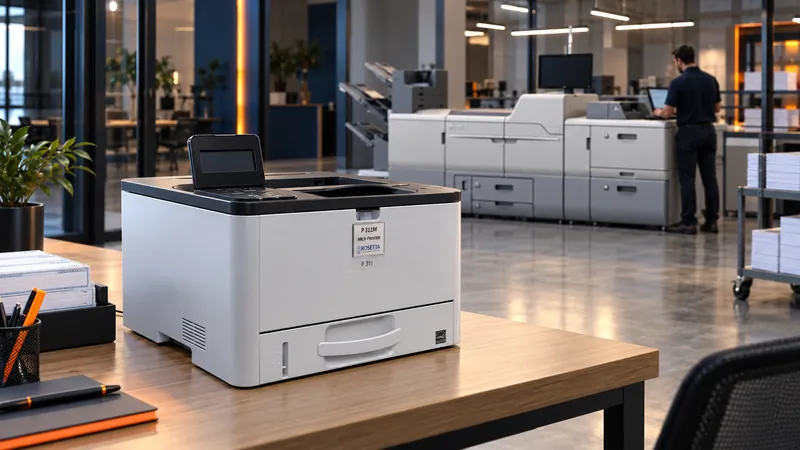
Size on volume, not on speed
- P 311M
- Up to 5,800 prints per month
- P 501M
- Up to 10,000 prints per month
- SP C840DNM
- Up to 50,000 pages per month
- IP C8500M
- Up to 50,000 prints per month
- SP 8400DNM
- Up to 53,000 pages per month
- Pro C7500PM
- Up to 240,000 pages per month
- Pro C7210XM
- Up to 240,000 pages per month
- Pro 8410M / 8420M
- Up to 1,000,000 impressions
- Pro 8310M / 8320M
- Up to 1,000,000 impressions
Recommended monthly volumes. The IP C8500M, Pro 8410M / 8420M and Pro 8310M / 8320M figures are maximum monthly volumes. Maximum duty cycle is a survival rating. Running near it wears the fuser and drum, and worn parts weaken the MICR signal.
Confirm it is actually a MICR printer
Three things have to be true, and only one of them is visible on a spec sheet.
- Magnetic toner. Always stated. Never the whole answer.
- Calibration verified on a MICR verifier before shipping. Ask whether each machine is individually verified, or whether the model was verified once. These are different claims.
- Certified E-13B or CMC-7 fonts tuned to that engine and toner. Ask whether the fonts are licensed and tuned to the specific engine, or generic font files that happen to be named E-13B.
A machine missing any one of the three produces output that looks correct and is rejected by a reader/sorter, often intermittently, which is the hardest failure mode to diagnose and the most expensive to live with.
Work out the cost of the reject rate
This is the calculation most buyers do not do, and it usually dominates the purchase price within the first year.
A rejected item leaves straight-through processing and is handled by a person at the bank, which the bank charges for at its own fee schedule. Typical MICR toner in this industry rejects at 2% to 4%. Our ProMark™ MICR toner is independently tested at a 0.1% reject rate or lower.
| Monthly volume | At 0.1% | At 2% | At 4% |
|---|---|---|---|
| 5,000 items | 5 | 100 | 200 |
| 20,000 items | 20 | 400 | 800 |
| 100,000 items | 100 | 2,000 | 4,000 |
Item counts are arithmetic applied to the stated rates. Multiply by your bank's per-item exception fee to get a monthly figure.
The second half of the cost is not billed. It is the internal handling: someone reconciling the exceptions, someone reissuing the items, and in payroll or claims, someone explaining to a person why they were not paid on the day they expected.
Understand the supplies commitment
A check printer is a consumables relationship, not a one-time purchase. Ask what that relationship looks like before signing, because it is where the real money is.
- Whether the toner is formulated for that specific print engine or sold as one universal MICR product
- What a maintenance kit contains, and what page yield it is rated for on your model
- Whether approved supplies are a condition of any performance guarantee, and what happens if you deviate
- Whether third-party supplies void anything, and whether that is stated in writing
- What the check stock specification is, and whether your current stock meets it
We formulate ProMark MICR toner per print engine rather than selling one universal product, which is the engineering reason behind the reject-rate difference. It is also why approved supplies are one of the five conditions attached to the MICR Performance Guarantee.
Decide about software and stock at the same time
A check printer on its own does not remove pre-printed stock from the building. Check printing software is what composes the whole item, background, logo, security features, and MICR line, onto blank safety stock in one pass.
Buying the printer first and the software later is common and usually costs more, because the two are configured together and the check layout is bank-specific. Decide both at once.
If the operation also handles returned items, that is a third question. Returns processing software reads an X9 cash letter file and produces Image Replacement Documents, which carry their own MICR line and therefore cannot be pre-printed.
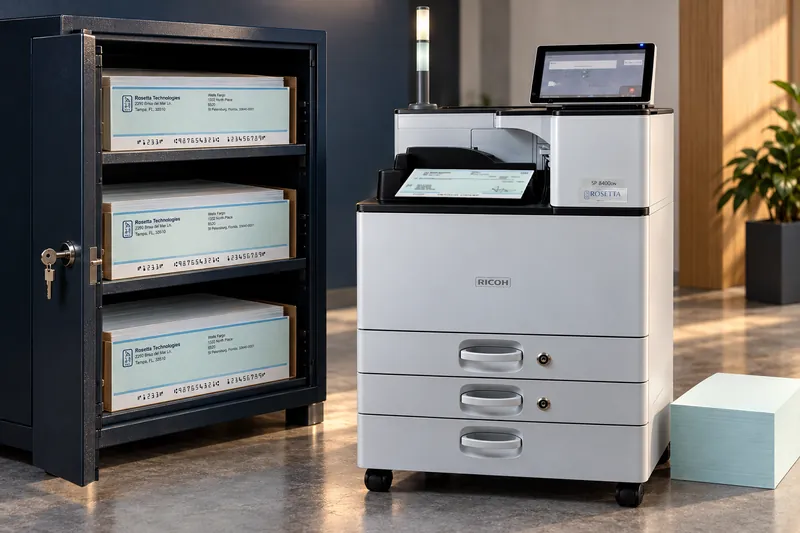
Why print on blank stock
Pre-printed stock
One product per account
- Ordered in quantity
- Stored under lock and counted
- Obsolete when a bank, address, or account number changes
- Destroyed, and reordered
Blank safety stock
One product covers every account, each check printed on demand
- Change a template, not an inventory
- Nothing to secure beyond the blank stock
- Nothing to destroy when details change
- Never short of a specific account’s forms
Questions to ask any vendor
Take these to every vendor on the list, including us. The answers separate them faster than a feature comparison.
- What is the recommended monthly volume, and is that different from the duty cycle?
- Is every machine individually verified on a MICR verifier before shipping, or was the model verified once?
- Are the MICR fonts licensed and tuned to this engine and this toner?
- What reject rate is the toner tested at, on what equipment, and by whom?
- What exactly does the performance guarantee pay for, and what conditions apply?
- What voids the guarantee, and is that list written down?
- What does a maintenance kit contain, what does it cost, and what page yield is it rated for?
- What check stock specification does this require, and does my current stock meet it?
- What are the support hours, and what is the response commitment?
- If this machine is replaced in five years, what happens to the software configuration?
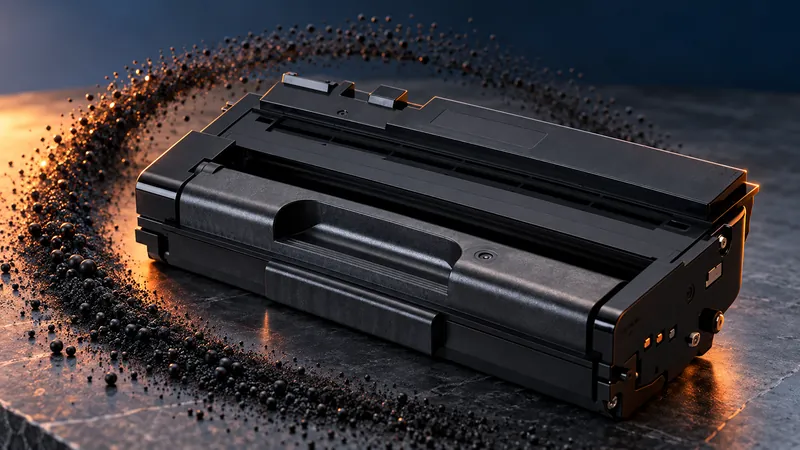
ProMark: why the base material matters
Polystyrene base
What most MICR toner uses
- Weaker cohesion
Polyester base
ProMark
- Stronger cohesion
- Higher heat tolerance
Five criteria evaluated on every formulation. Signal strength, adhesion, cohesion, durability, and toner life.
Common questions
How do I size a check printer?
Against recommended monthly volume, using your peak month rather than your average. Speed decides how long a run takes. Recommended volume decides whether the machine lasts and whether its MICR line stays inside tolerance. Duty cycle is a third number describing an upper limit rather than a workload.
What is the difference between recommended volume and duty cycle?
Recommended monthly volume is what the machine is built to do month after month. Maximum duty cycle is an upper limit. They can differ by a factor of five or more on the same model, and planning against the duty cycle is the most common sizing mistake in this category.
Is a more expensive MICR printer worth it?
Work out the reject cost first. At 20,000 items a month, the difference between a 0.1% and a 2% reject rate is 380 extra items a month going to manual handling at the bank, each carrying a fee. That figure usually dominates the purchase price difference inside a year.
Do I need check printing software as well?
If the goal is to stop buying pre-printed check stock, yes. The printer produces the MICR line; the software composes the background, logo, security features, and the rest of the item onto blank stock in the same pass. Decide both at once, since the check layout is bank-specific and the two are configured together.
Can I use my existing check stock?
Only if it meets ANSI X9.18, which specifies weight, surface smoothness, moisture content, sealed wrapping, and that the paper contain no ferromagnetic material. Stock outside that specification produces rejects on a printer in perfect calibration.
What should a performance guarantee cover?
Ask what it pays for and what conditions apply. Our MICR Performance Guarantee covers bank fees for rejected checks over the bank's acceptable rate where our materials caused the reject, subject to five conditions that apply together.
Talk it through with someone who builds these
We supply the printer, the software, and the toner, which is what makes the MICR Performance Guarantee possible at all. If any part of this applies to what you are trying to do, the fastest route is a conversation.