

Keep blank check stock in its sealed, moisture-proof wrapping until the moment it is loaded, open one ream at a time, and use opened stock before anything sealed. The wrapping is what holds the paper at the 4.5% moisture content ANSI X9.18 specifies (opens in a new tab), and a ream that has drifted looks exactly like one that has not.
Storage sounds like housekeeping. It is closer to calibration. A MICR printer can be in perfect order and still produce rejects if the paper feeding it has spent weeks soaking up the air of a damp room, and nothing about that paper will look wrong when you pick it up.
Why storage is part of print quality
ANSI X9.18, the standard for check stock, sets a moisture content of 4.5% and calls for moisture-proof package wrapping. Those two requirements travel together. The first describes the paper as it should be when it prints. The second exists to keep it that way between the mill and your printer.
Paper that has drifted from that moisture content does not only curl and feed badly. It also behaves differently through the fuser, and that is the part that matters for the MICR line. Laser printers fuse toner to paper with heat and pressure, and how well the toner bonds to the sheet affects the signal a reader/sorter sees. A change in adhesion is a change in signal strength, even when every character looks crisp to a person.
So the chain runs from the storeroom to the bank: a ream left open in a humid room changes its moisture content, the changed sheet fuses differently, the bond weakens, and the item becomes a candidate for rejection. We cover the specification itself in ANSI X9.18 and what it asks of check stock. This post is about keeping stock inside it.
Where stock goes wrong, stage by stage
Check stock passes through four places between delivery and printing, and each has its own way of going wrong.
| Stage | What can go wrong | The habit that prevents it |
|---|---|---|
| Receiving | A damaged or opened carton, with wrapping broken before the stock is ever used | Inspect every carton and confirm the seals are intact before it is signed for and shelved |
| Storeroom | Stock stored on edge, or near a source of damp, or where anyone can reach it | Store it flat, sealed and locked, away from exterior doors and anything wet |
| Opening | Several reams opened at once, so most of them wait unwrapped | Open one ream at a time, and only when the printer needs it |
| The tray | Stock left in an idle printer between runs, open to the room for weeks | Load what the run needs, and rewrap what is left after a short run |
Receiving and the storeroom
Inspect cartons on arrival. Box integrity is a security check, because blank safety stock is still the material checks are made from, and it is also a moisture check, because a torn carton often means torn wrapping inside it. A carton that arrives opened or crushed should be set aside and raised with the supplier before it joins the rest of the stock.
In the storeroom, store stock flat, because humidity changes how it feeds. Keep it locked: store check stock in locked facilities, even though blank stock carries no account number and no bank. And keep it in the same climate as the rest of the building, not next to a loading door or a window that lets in damp air.
Opened stock goes first
The single most useful storage rule is to use opened stock before sealed stock. Sealed reams are protected. An opened ream is exposed from the moment the wrapping breaks, and every day it waits is a day it spends adjusting to the room. Opening a fresh ream while a part-used one sits on the shelf means the part-used one waits longer, which is exactly the wrong way round.
- Open one ream at a time, and only when the printer is about to need it.
- When a run finishes with sheets left over, fold the wrapping back around them and use them first next time.
- Rotate sealed stock by delivery: the oldest sealed cartons are used before newer ones.
- In a low-volume office, treat the printer tray as storage. A tray that holds stock between monthly runs is holding opened stock.
- Keep IRD stock to the same rules. It is 24 lb stock that takes magnetic toner, and it fuses for the same reasons check stock does.
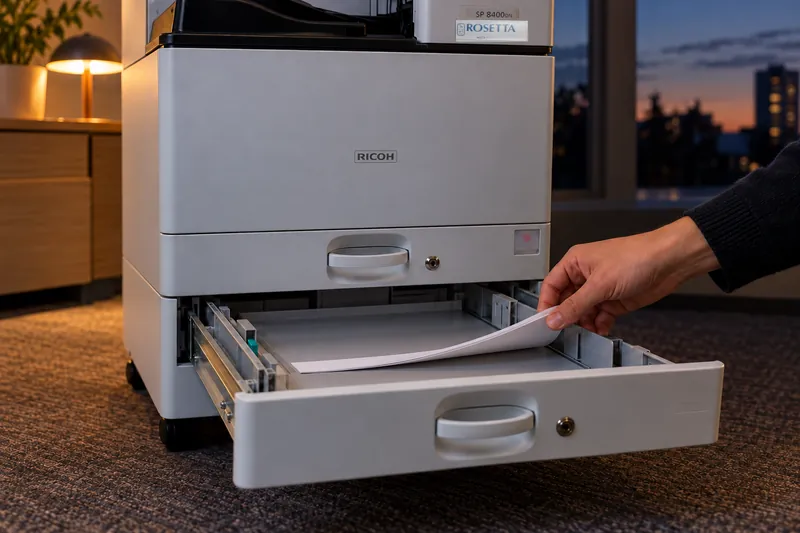
The tray point catches many smaller operations. A department that prints a handful of checks each week, or a payroll run every other week, can leave a ream in an open tray between runs without noticing that it has become the least protected paper in the building. Load what the run needs, and put the rest back in its wrapping. A locking tray keeps stock secure in the printer, but it does not keep the room air out.

When you are not sure about a batch
Sometimes stock has been stored badly before anyone noticed: a carton left open over a holiday, a shelf next to a leaking window, a pallet stored somewhere it should not have been. There is no visual test that settles it, and guessing is how a reject rate starts.
If a batch is in doubt, keep it apart from good stock and do not use it for a payroll or claims run. If you want a firm answer, a paper evaluation can test a sample from the doubtful batch in our printers before any of it goes near a live run. And if your reject rate starts climbing, stock storage belongs on the short list of things to check, next to the maintenance kit yield and any change of supplies. The check stock requirements are worth keeping beside the storeroom door for whoever receives deliveries.
The conditions in the room itself, temperature and humidity across the year, are a subject of their own. We cover them in humidity, temperature and the print room.
We do not publish storage temperature or humidity ranges for check stock. Ask your stock supplier for the conditions its paper is made for, and store it within them.