

A returned item is a check that was sent forward for payment and came back unpaid, for insufficient funds or another reason. It travels back toward the bank where it was deposited as a record in an electronic cash letter, and the bank that receives it has to decide what happens to it next. If the answer is a chargeback, the record also has to become a printed document.
Returns are the half of check processing that most people outside a bank never see. A check is written, deposited and sent on its way, and for most items the story ends there. When it does not, the item reverses direction, and the parties it passed on the way out each have a part in sending it back.
Forward items and return items
Check processing has its own vocabulary, and returns make sense once a few terms are clear. These are the parties and documents an item meets, roughly in the order it moves:
- Bank of first deposit (BOFD): the bank where the check was deposited.
- Payor bank: the bank the check is drawn on, which decides whether to pay it.
- Intermediary: the Federal Reserve or a large bank processing checks between the two.
- Correspondent bank: a bank that provides check processing and IRD printing to other banks.
- Cash letter: the document that accompanies a bundle of checks and describes its contents, item count and dollar amounts. An electronic cash letter carries the same information plus the check images and data.
An item moving from the bank of first deposit toward the payor bank is a forward item, sometimes called day one. An item coming back the other way is a return item, or day two. The rest of the vocabulary, including substitute checks and the Check 21 terms, is in the Check 21 and IRD section of our FAQ.
A return is not the same as a reject
The two words get used loosely, and they describe different events. A reject happens in processing: a reader/sorter could not read the MICR line with confidence, so the item left straight-through processing and a person at the bank handled it by hand. A return happens after the item was read and presented: the payor bank did not pay it and sent it back.
The distinction matters because the remedies are different. A reject rate is a print quality problem on the issuing side, the thing that toner, calibration and fonts control. A return is a payment problem, and it comes back with a reason attached. In a returns operation, that reason is one of the facts that decides what happens to the item next.
How a returned item arrives
A return item arrives as a record in a cash letter file. For a bank or correspondent processing returns, that file downloads from the provider's secure folder. OnSight returns processing accepts files in ASC X9.37, ASC X9.100-180 and ASC X9.100-187, and PDF returns from the Federal Reserve.
Before electronic files, a returned item came back as paper. That meant waiting for a courier or the postal service to deliver it, and the wait was time the receiving bank could not use for anything else. An electronic file removes the transport. It does not remove the need for paper at the end, because a returned item has to become a physical document before it can be charged back.

What the receiving bank has to do
Once the file is in, each item needs a disposition, and there are three to choose from:
- Re-present it. The item goes back for payment.
- Charge it back. The item is printed and mailed to the bank's customer, the depositor, as a chargeback.
- Hold it as an exception. The item is flagged for a person to review rather than decided automatically.
Which one fits depends on the item: its amount, how many times it has already been presented and the reason it came back. Those are the three criteria OnSight Decision applies to each item in an incoming X9 Image Cash Letter file, against rules the bank sets. We take the choice itself apart in re-present or charge back.
The decision is also time sensitive: hold an item too long and re-presenting it stops being an option. The time limits that govern your items are a question for your bank or provider, and they are worth knowing before the volume arrives rather than after.
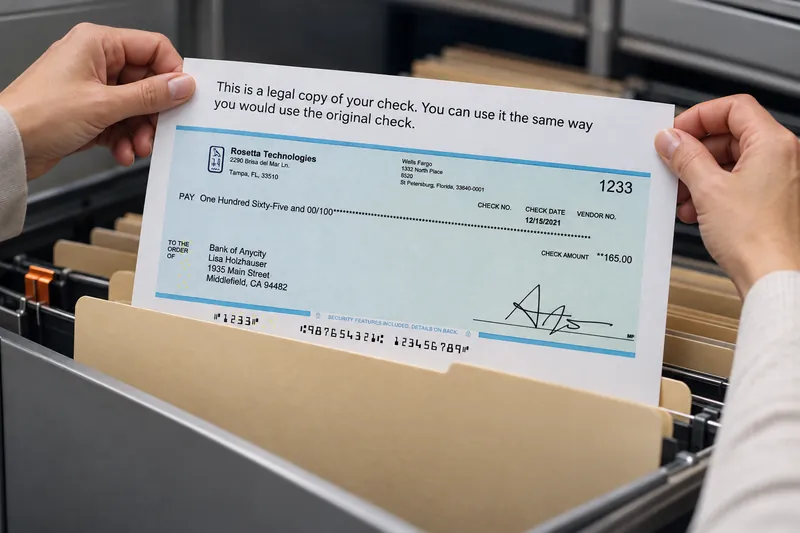
If the item is going to the customer as a chargeback, it needs a paper form. Under the Check 21 Act, a US federal law, that form is a substitute check, also called an Image Replacement Document, which serves as the legal equivalent of the original when it is properly prepared. We explain the document itself in what an Image Replacement Document is. The part that matters here is that an IRD carries its own MICR line, so it has to be printed with magnetic toner on blank IRD stock when the item is in hand, not before.
What a business on the receiving end sees
For the business that deposited the check, a return shows up as a chargeback from its bank. The item is charged back to the account it was deposited into, and a notice arrives. A complete chargeback normally involves four things: the notification, an explanation of the charge, a legal rights disclosure and the IRD itself.
If you are on that side of the transaction, these questions are worth one call to your bank:
- How it notifies you of a returned item, and in what form the notice arrives.
- Whether a returned item is re-presented before it is charged back to you, and on what basis.
- What the return reason on a charged-back item means, in plain terms.
- Who to contact when a returned item does not match your own records.
For a bank, the same four pieces are the end of the process: the point where a record in a file becomes a document in a customer's hands. Getting there quickly and correctly, item after item, is what returns processing is for.
Return reasons, time limits and the rules for re-presenting an item depend on law, on clearing arrangements and on your bank agreement. Where a decision depends on them, ask your bank or your provider.