

What an IRD carries
- Images of the original itemFront and back
- Its own MICR lineSpecific to this item
- ASC X9.100-140The governing specification
- Legally equivalentSubstitutes for the original
- Blank IRD stock24 lb ProMark, two-perf
Printed on demand, because the MICR line is specific to the item.
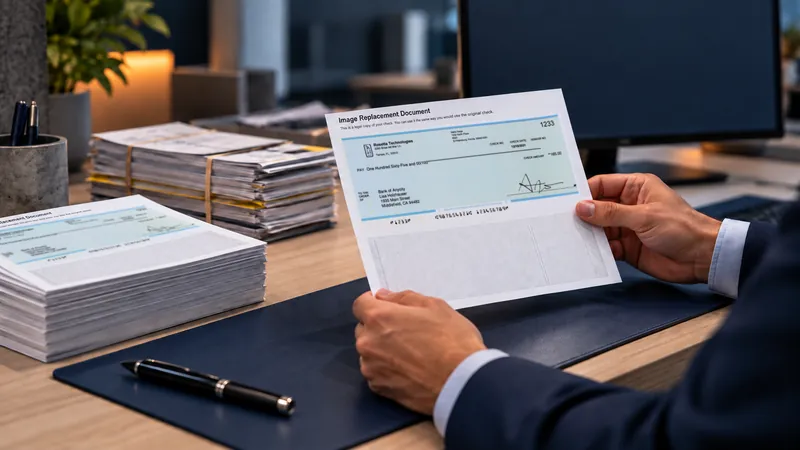
An Image Replacement Document, usually called an IRD, is a piece of paper that stands in for a check. Check 21 took effect on October 28, 2004, and the substitute check it created is the reason IRDs exist.
The definition that matters is short: an IRD is a paper substitute with the legal standing of the original. Not a copy for reference, not a notice, not a courtesy print. It carries the standing of the item it replaces.
It carries its own MICR line
An IRD has a MICR line of its own, derived from the original item. That line is what allows the substitute to move through the same processing as any other paper item: it is read magnetically, by the same reader/sorters, against the same standard.
Because the line is derived from the original, its content is different for every IRD. It is determined at the moment the substitute is produced, from the item being replaced.
This is why an IRD cannot be printed on pre-printed stock. Pre-printing requires knowing the content in advance and committing it to paper in bulk. Here the content is not knowable in advance, and it changes item by item. The document and its MICR line must be produced together, on blank stock, on demand.
What that requires of the printing
Producing an IRD is MICR printing, with the same three requirements as any other MICR printing, and no allowances for the fact that the work is reactive rather than scheduled.
- Magnetic toner. The IRD MICR line is read magnetically, so it needs toner containing iron oxide, formulated for the print engine producing it.
- Verified calibration. The machine must be inside tolerance for signal strength, character formation, and spacing, measured on a MICR verifier rather than assumed.
- Certified fonts. Certified E-13B fonts, tuned to that engine and that toner. The line has to produce the right waveform, not merely the right digits.
The stock has requirements too. Blank check stock conforming to ANSI X9.18, which means 24 lb weight recommended, Sheffield smoothness of 120 to 150, moisture content of 4.5%, sealed moisture-proof wrapping, and no ferromagnetic material in the paper.
Why the timing makes this harder
A scheduled check run can be planned. Test one, verify it, run ten, verify those, then commit. A returns process does not have that luxury in the same way, because the volume arrives when it arrives and the items involved are already late by definition.
The answer is to move the verification off the critical path. Verify the machine on a schedule tied to page counts and to changes in the system, so that when a file lands, the question of whether the printer is inside tolerance has already been answered.
Cash letter files are the input to all of this. X9.37 is the format, succeeded by X9.100-187, and the work of receiving a file, applying industry and business rules to it, and producing correct paper output is a data process feeding a print process.
The record
One more consequence follows from the legal standing. When a document substitutes for an original, what was done to it, when, and under which rule may be asked about long after the event.
A returns process therefore needs a durable record of what happened to each item, not just a printer that produces good IRDs. The print quality determines whether the item clears. The record determines whether you can explain it afterwards.
Why pre-printing is not merely inconvenient here
It is worth separating two reasons an operation might avoid pre-printed stock, because only one of them applies to IRDs.
For ordinary check printing, avoiding pre-printed stock is an economic judgment. Pre-printed forms carry storage, obsolescence, reorder lead time, and one stock item per account, and many organizations conclude that printing the whole check onto blank stock costs less overall. That is a decision with two defensible answers.
For IRDs there is no decision to make. The MICR line is derived from the original item and is therefore unknown until the item is in front of you. Pre-printing a line that does not exist yet is not expensive or awkward. It is impossible.
What an operation needs to have in place
Putting the pieces together, a returns desk producing IRDs needs five things working at the same time.
- A way to receive and read the cash letter file, in X9.37 or X9.100-187.
- Rules, both industry and business, applied consistently to what the file contains.
- A MICR capable printer: magnetic toner, verified calibration, and certified E-13B fonts tuned to that engine and toner.
- Blank stock conforming to ANSI X9.18, stored in its sealed wrapping so it stays at the specified moisture content.
- An audit record of what was done to each item, retained for as long as anyone might ask.
The first two are data problems, the next two are printing problems, and the last one is the problem that only becomes visible when somebody asks a question about an item from a year ago.
Operations that handle returns well tend to treat those five as one process with one owner rather than as a printing task attached to a data task. The item that reaches a payee is the output of all of it, and a failure anywhere in the chain looks the same from the outside.
The summary we would give somebody setting this up for the first time is short. An IRD is a real check for every practical purpose, it is produced on demand because its MICR line cannot be known in advance, and every rule you already follow for printing checks applies to it without exception.
Which items reach you as images, which as IRDs, and in which file format, is determined by your institution and its exchange partners.