
A bank is the one buyer that sits on both sides of the MICR line. It prints items that have to clear, such as official checks, cashier checks and money orders, and it receives items that have to be read, returned and replaced. Both jobs depend on the same magnetic line, which is why we supply both from one place.
Most organizations that print checks only ever see one direction. A payroll department prints, mails and waits to hear whether anything was rejected. A bank does that too, and then handles items moving the other way: returned items that arrive as records in a cash letter file and have to leave as physical documents carrying a MICR line of their own. Both directions run on a clock that does not move.
The outbound side: items the bank issues
Official checks, cashier checks and money orders are produced against a cutoff, and that one fact shapes most of the equipment decision: speed, paper capacity, toner yield and service cover all have to hold for the length of the window.
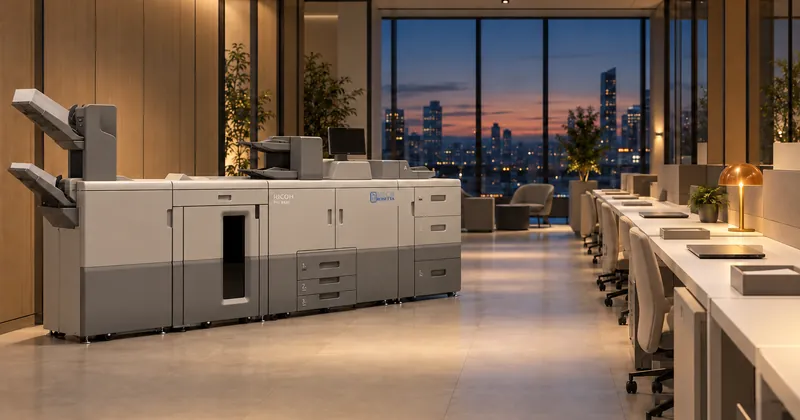
The machines built for that work are our production systems. The Pro 8410M/8420M and Pro 8310M/8320M run to 1,000,000 impressions a month at 111 or 136 pages per minute. Where the output needs color, the Pro C7500PM and Pro C7210XM carry up to 240,000 pages a month and print the background, the security features and the MICR line in one pass.
Composition matters as much as the engine. CheckStream® composes the whole item onto blank safety stock, so no account has its own pre-printed inventory. One stock covers every account, which removes the per-account forms and the obsolescence that arrives with them whenever a detail changes.
The inbound side: items that come back
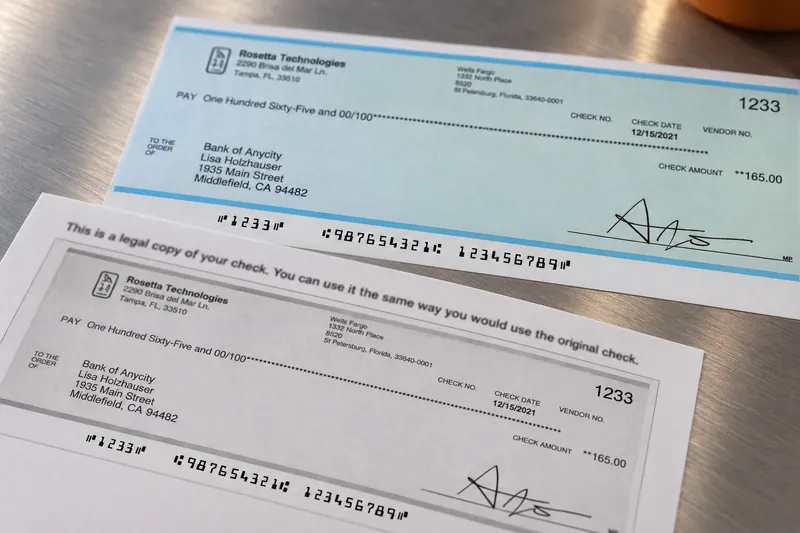
A returned item has to become a physical document before it can be presented again or charged back. That document is an Image Replacement Document, the legal equivalent of the original item, and it carries a MICR line specific to itself. Because the line differs on every document, it cannot be pre-printed. Blank IRD stock plus magnetic toner is the only combination that works.
OnSight returns processing is the system we sell for that job: software and a MICR printer together. It reads X9.37, X9.100-180 and X9.100-187 cash letter files and produces Image Replacement Documents that comply with X9.100-140. OnSight Decision adds a decisioning engine on top. It looks at the item amount, the number of times the item has been presented and the return reason code, then routes each item to re-present, charge back or exception for a person to review.
Output from OnSight prints only on its paired OnSight MICR printer. Every laser engine behaves differently, so the software and the printer are designed together to land print elements correctly on each IRD. The pairing also removes the possibility of redirecting output to another device.
What the two sides have in common
On an organization chart the two jobs sit in different places. At the MICR line they are the same job.
| Question | Items the bank issues | Items that come back |
|---|---|---|
| What is printed | Official checks, cashier checks and money orders | Image Replacement Documents |
| What it is printed on | Blank check safety stock | Blank IRD stock |
| What composes it | CheckStream, from the account data | OnSight, from the cash letter file |
| What the line has to do | Read on a reader/sorter the first time | Read again when the item is presented again |
| What a failure becomes | A fee and handling by hand | An item somebody works by hand before it can move |
Both sides depend on the same three things: magnetic toner, calibration verified on a MICR verifier, and certified E-13B or CMC-7 fonts tuned to that engine and that toner. Both are governed by ASC X9 and ABA specifications. And both fail the same way. An item a reader/sorter cannot read stops being a print job and becomes a person opening an envelope by hand.

Why one supplier for both sides
A typical check print path involves three suppliers: one for the printer, one for the software and one for the toner. When an item is rejected, each can point at the other two. We supply all three, which is why the reject rate can be one supplier's responsibility rather than three.
The toner is where most of the difference shows up. We formulate ProMark™ MICR toner per print engine, and it is the first polyester-based MICR toner in the industry. In independent testing it rejects at 0.1% or lower, where typical MICR toner rejects at 2% to 4%. As an example, on a run of 10,000 items that is the difference between 10 or fewer rejected items and 200 to 400 of them.
The MICR Performance Guarantee rests on the same arrangement. It pays bank fees for rejected checks over the bank's acceptable rate where our materials caused the reject. Five conditions apply together, among them approved supplies and continuous maintenance under an approved service plan, and our MICR Performance Guarantee page lists all five.
Questions worth settling first
- What acceptable reject rate applies to the items you issue, and where are you against it? If nobody knows, that is the first number to find.
- How many return items do you handle, and how many are keyed by hand? The second number is the one that decides whether decisioning pays for itself.
- Does the outbound run need color and an invisible security feature, or is monochrome volume the priority?
- Which service plan covers a fault during the nightly cycle? Production printers qualify for 4-Hour Response coverage 24 hours a day, 7 days a week.
Our page for banks and financial institutions sets out the printers, software and supplies for both sides in one place, along with the questions we ask before recommending any of them.